How Much Should a Full Villa Interior From China Cost in 2026?
“You want the whole villa done — kitchen, wardrobes, doors, flooring, lighting. What will it cost?” This is the most-asked question in the inbox, and the honest answer is not a number, it is a range with a method. The planning numbers in circulation for 2025–2026 put a full-house package (fixed millwork plus loose furniture and finishes) at roughly $450–$800 per sqm for a mid tier, $800–$1,400 for high, and $1,400–$2,800+ for luxury — a 220 sqm luxury villa at $1,900/sqm lands near $418,000 before duties and installation labour. Meanwhile a 2026 sourcing comparison for a standard 4-bedroom luxury villa (about 370 sqm) puts the materials-only subtotal at $50,000–$73,000 from a Chinese turnkey supplier versus $127,000–$182,000 at local retail, before a single container is booked. Both numbers are real. They are also measuring different things — and the difference between the two is exactly what this article walks through: the tier table, the room-by-room breakdown, the landed-cost math, and the five questions that tell you whether two quotes are even comparable.
In This Guide
- The One Number to Plan With: Cost per Square Metre, by Tier
- What a Real 4-Bedroom Villa Package Costs in 2026
- The Landed-Cost Math: What the Quote Doesn’t Show
- Why Two Quotes for the Same Villa Can Differ by Half
- Where the Money Actually Goes — and How to Move It
- The Timeline Cost: Speed Is a Line Item Too
- The 5 Questions to Ask Before You Compare Any Quote
- Frequently Asked Questions
- How much does a full villa interior from China cost in 2026?
- Is a China villa interior really cheaper than buying locally?
- What is included in a “full villa interior” package — and what is not?
- How much does a custom kitchen from China cost per linear foot?
- How long from design freeze to delivered villa interior?
- How much contingency should I carry on the procurement budget?
The one number to plan with: cost per square metre, by tier
Per-square-metre is the unit that lets a 370 sqm villa and a 220 sqm villa sit in the same spreadsheet. A 2025 FF&E cost guide by a China sourcing firm — which is explicit that its ranges exclude duties, installation labour and MEP work — breaks the market into three tiers, and the tiers describe what the money buys, not just how much it costs. Mid tier, $450–$800/sqm, is modular cabinets, HPL or engineered-stone tops, LVT or laminate floors and mid-grade sanitary. High tier, $800–$1,400/sqm, is custom millwork, engineered or stone tops, engineered-wood floors and branded fixtures. Luxury tier, $1,400–$2,800+/sqm, is bespoke millwork, premium stones and metals, designer lighting and high-end sanitary suites. The guide’s worked example for a 220 sqm luxury villa — island kitchen with pantry, four bathrooms, extensive bespoke millwork, premium stones and designer lighting — runs $1,900/sqm, about $418,000, with documented sensitivities of roughly +$60,000 if natural stone is extended into secondary rooms and −$45,000 if you shift to engineered veneers and rationalise the door hardware. One more calibration that keeps the tiers honest: a furniture-only budget at the same quality is only 30–60% of the full-house package — the built-ins and finishes are what move the curve, which is why a quote that looks cheap on sofas can still be expensive in the kitchen.
What a real 4-bedroom villa package costs in 2026
The room-by-room view is where the planning gets concrete. A Foshan turnkey supplier’s April 2026 sourcing guide benchmarks a standard 4-bedroom luxury villa (about 4,000 sq ft / 370 sqm) and prices each category at local retail against direct-from-China materials. Treat it as supplier-sourced estimates, not an independent survey — but it is the most detailed published breakdown in 2026, and every row is a line item your own quote should contain.
| Category (whole house) | Local retail (USD) | China direct (USD) | Saving |
|---|---|---|---|
| Custom kitchen (cabinets, stone island, hardware) | $45,000 – $60,000 | $18,000 – $25,000 | ~60% |
| Custom wardrobes & closets (master walk-in + 3 bedrooms) | $30,000 – $45,000 | $12,000 – $18,000 | ~60% |
| Bath vanities & smart mirrors (4 bathrooms) | $15,000 – $22,000 | $6,000 – $9,000 | ~60% |
| Premium flooring & wall cladding (large format) | $25,000 – $35,000 | $10,000 – $14,000 | ~60% |
| Statement lighting (lobby chandelier, LED) | $12,000 – $20,000 | $4,000 – $7,000 | ~65% |
| Subtotal — materials only | $127,000 – $182,000 | $50,000 – $73,000 |
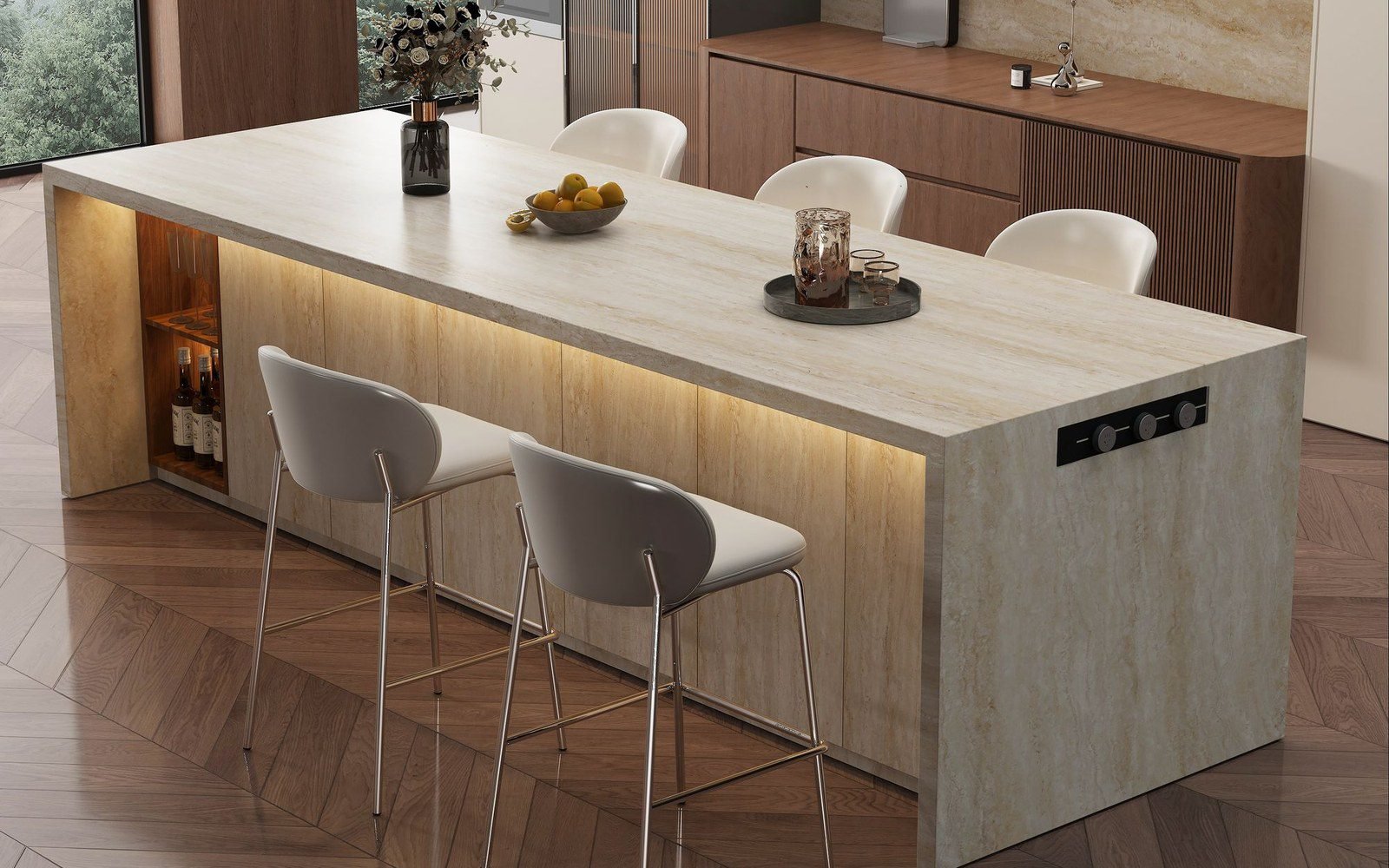
Two structural notes on that table. First, the gap is not a factory discount on the same shelf — it is the removal of the middle: the guide’s chain runs factory cost, exporter margin, local importer margin, showroom overhead, and a final retail markup it documents at 100–300% in the markets it covers. Sourcing direct deletes steps two through five. Second, the kitchen and the wardrobes are the two heaviest rows, which matches the composition data from the per-sqm guide (cabinets and wardrobes around 28% of a full-house budget) — if your comparison quotes treat those two rooms as the “cheap part”, that is the first red flag to note down, in the same spirit as the quotation red-flags article handles it for the rest of the commercial terms.
The landed-cost math: what the quote doesn’t show
The number that decides the project is not the EXW (factory-gate) price — it is the landed cost, and the landed cost is a stack. The 2025 FF&E guide’s stack: EXW price, inland trucking to port plus terminal handling, ocean or rail freight plus insurance, duties and tariffs plus VAT/GST, customs brokerage, last-mile delivery and inside handling, and a damage allowance of 1–3% depending on packaging rigour. Its worked example for a 100 sqm high-tier package produced in China: $105,000 EXW + $2,800 inland and consolidation + $3,200 for one 40′ HC + duties modelled at a 10–25% blend for US landing + $2,000–$5,000 last mile + 1.5% damage reserve — against a local/regional bid that runs +10–35% on the same specification in many markets, with its own freight and tariff exposure removed. The 2026 villa guide’s logistics lines are in the same band: $4,000–$8,000 for FCL ocean freight and port fees depending on destination, plus import duties typically 5–15% of material value, and its conclusion is that the net saving after the container and the taxes still runs $50,000–$80,000 on a 4-bedroom villa. Two honesty flags on the duty line. For the United States, timber-derivative adjustments under Section 232 were formalised in late 2025 and Section 301 rates can stack on top for China-origin goods — the 2025 guide’s own instruction is to verify HS codes and current rates in the Federal Register before modelling, and our sea freight timeline carries the destination duty table for the main villa markets. For Europe, MFN furniture duties stay in the low single digits under HS 9401/9403, with VAT adding roughly 17–27% by member state. The guide’s bottom line is the one to keep: factory-direct keeps its advantage in markets with high local labour and material costs; in moderate-pricing markets with heavy tariffs the gap narrows or flips — so run the math with your HS codes, your origin and your destination, not with someone else’s. The interior pricing guide breaks this same gap down by package type, which is where to start before you ask for a quote at all.
Why two quotes for the same villa can differ by half
Per-linear-foot is the kitchen’s comparison unit, and it is where half the price confusion lives. A sourcing agent’s guide to Chinese cabinet pricing is blunt about why: the per-linear-foot figure only means anything if it refers to the same build — the box construction and board grade, the door material and finish, the hardware brand and mechanism, and the design profile each move the number, and “a quote that does not state these is a price for an unknown cabinet; comparing two unknowns is a guess, not a decision”. The same guide notes where cheap quietly becomes expensive: a basic hinge holds the price down but the door sags over time, and a kitchen needs a moisture-resistant board grade or the box swells. The American benchmark makes the comparison concrete: a January 2026 China-vs-US budgeting comparison documents US stock cabinets at $230–$290 per linear foot, semi-custom at $320–$400, custom at $450+, plus $70/LF for installation and design fees of $100–$300/hour charged even when the client never buys — against a Chinese system where raw materials run about 30% below US levels and the design fee (typically ¥12/m²) is waived when you purchase with the same company. A 2026 import guide for kitchen cabinetry puts the buyer-side conclusion at 20–50% savings versus local custom depending on the project. That is the band to hold every quote against — and the contract article is where the same-spec requirement belongs in writing, so the comparison is contractual, not verbal.
Where the money actually goes — and how to move it
Once the spec is fixed, the cost drivers are few and they are knowable. The 2025 guide’s 80/20 list, in order of leverage: materials and finishes (solid wood versus engineered, veneer thickness, HPL versus lacquer versus natural stone, upholstery grade); compliance standards (fire performance for upholstery, electrical certifications — costlier, and not optional); hardware and fixture grade (hinge and slide brands and cycle ratings, cartridge types, lighting housings); standardisation (shared cabinet modules, repeatable finish schedules, common hardware SKUs); engineering and packaging (flat-pack feasibility, KD joinery, export-ready pack); and logistics and duties (route, mode, tariff exposure). The value-engineering moves that preserve design intent follow directly: standardise dimensions and finishes; engineer for flat-pack where the joinery allows; substitute engineered veneer for solid on large faces and engineered stone for natural stone in secondary areas; rationalise lighting into families of fixtures with shared drivers. The guide’s expectation-setting line is worth stealing for your own negotiation: VE typically unlocks several points of savings without changing the look — and the biggest wins come from standardisation and scope clarity, not from single-line item swaps. And whatever the VE does, the guide carries 7–12% contingency on procurement packages depending on design maturity and logistics volatility, with 1–3% of finishes and hardware held back as spares. That is the same discipline the pre-shipment inspection article applies on the quality side: spares and documentation are budget lines, not favours.

The timeline cost: speed is a line item too
The last cost is the one that never appears in a price table: the calendar. The 2025 guide’s realistic chain for international sourcing runs design freeze and submittals 1–3 weeks, sampling and approvals 1–4 weeks, production 4–12+ weeks, consolidation and pack-out 3–10 days, ocean transit roughly 23–30 days to the US West Coast, 32–40 to the East Coast and 30–45 to Europe, customs 3–7 days, last-mile and site positioning 2–7 days — a full door-to-door cycle of about three to five months before anything is standing in your villa, which lines up with the sea freight timeline published this week. The cost shows up at the interfaces, where the guide plans buffers: approvals, pre-shipment QC and the port-to-site stretch. It also shows up in what you choose not to wait for — the playbook reserves air freight for small critical lots (replacement parts, one statement fixture) and keeps the volume on the water, and it builds 1–2 week buffers around Golden Week and Lunar New Year when Chinese factory capacity thins. A villa project that freezes its design two months late does not get a two-month discount anywhere in the chain; it gets a two-month delay, a rebooked container and a site that has to re-sequence installation. In the budget, “time” is the line item that pays for itself by not being spent.
The 5 questions to ask before you compare any quote
The questions are the product. Ask all five of every supplier, in writing, and the quotes become comparable.
1. Is this EXW, FOB, or landed? — If the answer is not landed, ask for the stack: freight, insurance, duties, brokerage, last mile, damage allowance. A price without its Incoterms is a starting point, not a number.
2. What exactly is in “full villa interior”? — Loose versus built-ins separated, by room, with the finishes schedule attached. The two scopes differ by 30–60% at identical quality.
3. Which hardware brands and which board grades, per room? — The per-linear-foot number only compares when the build matches; a quote that hides the hinge brand and the board grade is pricing an unknown cabinet.
4. What QC plan is in the price? — Pre-production, in-process and pre-shipment checkpoints, an AQL sampling plan (the working defaults are critical 0 / major 2.5 / minor 4.0), and an ISTA-style packaging specification. The inspection guide is the checklist version.
5. What is excluded? — Installation labour, site readiness, MEP coordination, permits, spares. The 2025 guide’s list of what headline budgets usually leave out is the list to append to your PO, because silent scope creep is the most expensive line in the project.
Frequently asked questions
How much does a full villa interior from China cost in 2026?
Use per-square-metre tiers: roughly $450–$800/sqm for a mid package, $800–$1,400 for high, and $1,400–$2,800+ for luxury, before duties and installation labour. A 220 sqm luxury villa works out near $1,900/sqm (about $418,000) in the 2025 planning data, and a 4-bedroom 370 sqm villa’s materials-only subtotal runs $50,000–$73,000 direct from China versus $127,000–$182,000 at local retail in the 2026 supplier comparison.
Is a China villa interior really cheaper than buying locally?
Usually, yes, at the factory level: the 2026 villa guide documents roughly 60% savings per category before logistics, and 2026 import guides cite 20–50% savings for custom cabinetry. The landed math is what decides it — add ocean freight ($4,000–$8,000 FCL typical), duties (5–15% in most villa markets; 232/301 stacking possible for US timber-derivative goods) and last-mile handling, and the guide’s model still leaves $50,000–$80,000 on the table for a 4-bedroom villa — but in moderate-pricing markets with heavy tariffs the gap narrows or flips, so run it with your own HS codes and destination.
What is included in a “full villa interior” package — and what is not?
Typically included: kitchen cabinets and worktops, bathroom vanities and sanitary, built-in wardrobes, interior doors and hardware, flooring, fixed lighting and loose furniture. Typically excluded unless written in: on-site installation labour and site readiness, duties/tariffs and VAT/GST, customs brokerage, last-mile inside delivery and white-glove handling, MEP and electrical wiring for fixed lighting, and permitting. Put each exclusion on its own line in the purchase order.
How much does a custom kitchen from China cost per linear foot?
There is no fixed tag — the per-linear-foot figure is a scaling unit, not a product price. Four drivers set it: box construction and board grade, door material and finish, hardware brand and mechanism, and the door profile. The US benchmark is $230–$290/LF stock, $320–$400 semi-custom and $450+ custom, plus $70/LF installation; a Chinese factory quoting the same spec at the same linear foot should land materially below that, and any quote that does not state the build is not comparable.
How long from design freeze to delivered villa interior?
About three to five months end to end: design freeze and submittals 1–3 weeks, sampling and approvals 1–4 weeks, production 4–12+ weeks, pack-out 3–10 days, ocean transit 23–45 days by route, customs 3–7 days, last mile 2–7 days. Plan buffers at the three interfaces — approvals, pre-shipment QC and the port-to-site stretch — and add 1–2 weeks around Lunar New Year and Golden Week.
How much contingency should I carry on the procurement budget?
Working defaults from the 2025 FF&E guide: 7–12% contingency on the procurement package depending on design maturity and logistics volatility, a 1–3% damage allowance built into landed cost, and 1–3% of finishes and hardware held back as labelled spares. The contingency is not wasted money — it is the difference between a rework that costs a weekend and one that costs a rebooked container.
Send us your floor plans and a finishes schedule, and we will return a line-item budget — per sqm by tier, room by room, EXW and landed — with the exclusions listed before you commit.