Marble, Sintered Stone or Porcelain Tiles: Flooring for New Villas
A new villa floor plan carries three names, and each of them can be right: marble, sintered stone, porcelain tile. The debate between sintered stone vs marble has a clean technical answer and an emotional one, and the marble vs porcelain tiles comparison has a third answer hiding in the maintenance column. This article puts all three in one table with the numbers a specification sheet needs — hardness, absorption, strength, thermal behaviour, maintenance — and then walks through where each material wins in a real house, what heat and humidity do to each one, and what the three of them cost in 2026.
It is written from the factory side: our plant sits in the same Foshan cluster where the sintered-stone slabs in the data below are pressed, and we specify marble, sintered stone and porcelain for villa floors every month. The performance figures come from a September 2026 technical comparison (stonefuntek, 2026-09-06), a September 2026 porcelain-vs-marble guide (specceramics, 2026-09-15), an August 2026 slab-vs-tile comparison by a Foshan listed manufacturer (Monalisa, 2026-08-05) and a September 2026 price guide (stonefuntek, 2026-09-06) — all industry-side accounts, cited where used, and all marked as planning references rather than a quotation.
The three materials, in one table
Start with the material, not the marketing. The two 2026 technical guides, read together, cover the same core indicators for sintered stone and porcelain with ISO/EN test references, and the porcelain-vs-marble guide supplies the marble column. The consolidated table for a villa floor:
| Indicator | Marble (natural) | Sintered stone slab | Porcelain tile |
|---|---|---|---|
| Mohs hardness | Relatively soft — a standard knife can scratch it; varies by variety and quarry | 7–8 | 5.5–7 (glazed slab) to 6–8 (through-body); PEI IV products documented at 8+ |
| Water absorption | Varies by stone type — some varieties nearly impermeable, others absorb readily and stain | ≤0.05%, often around 0.02% (manufacturer reference ≤0.08%) | ≤0.5% (TCNA/PTCA impervious definition, ASTM C373) |
| Flexural strength | Natural-stone range; the same 2026 source puts comparable natural stone (granite) at approx. 15–24 MPa | ≥45 MPa, up to 67 MPa (EN ISO 10545-4) | approx. 24–35 MPa (EN ISO 10545-4) |
| Thermal shock | Good indoors; the 2026 guides do not list marble for outdoor use | Excellent — direct contact above 400 °C without thermal-shock fracture (ISO 10545-9) | Good; sudden local temperature differences can still crack it |
| UV stability | Not addressed for outdoors in any of the four 2026 sources reviewed | UV-stable surface options; the recommended outdoor direction | UV stable (large-format); the recommended outdoor direction |
| Fire rating | A1 non-combustible | A1 non-combustible (EN 13501-1) | A1 non-combustible |
| Maintenance | Sealing, pH-neutral cleaners, vein-matching at install; periodic re-polishing over decades | No routine sealing; low-maintenance cleaning | Minimal sealing; match PEI rating to traffic |
| Look | One-of-a-kind natural veining; no two slabs match | Controlled design, marble-look at up to 98% visual realism | Consistent within a dye lot; marble-look collections available |
Read the absorption row against the maintenance row and the whole argument becomes visible: the softer, more porous material is also the one with the longest care schedule. Every row above is a planning reference from the four dated sources — the slab you actually buy should be checked against its own datasheet and test report, as both technical guides instruct.
Where each one wins
The September 2026 porcelain-vs-marble guide frames the decision exactly the way we brief it on project calls: room use, moisture, and maintenance tolerance drive the choice — not the material name. Walked through a villa, room by room:
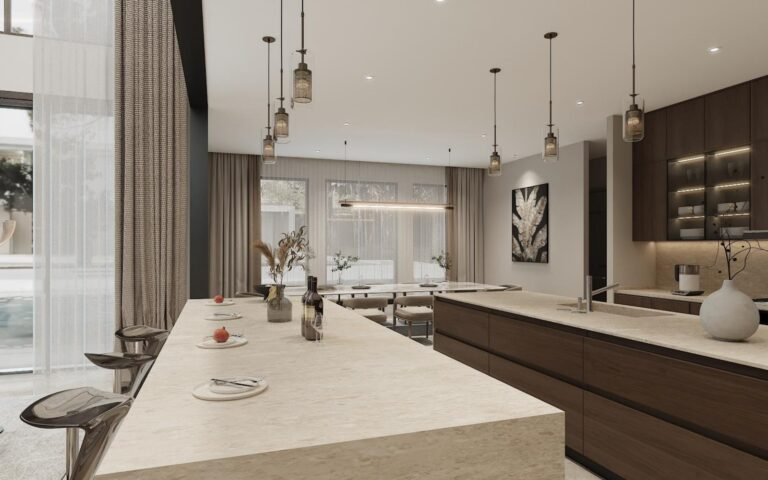
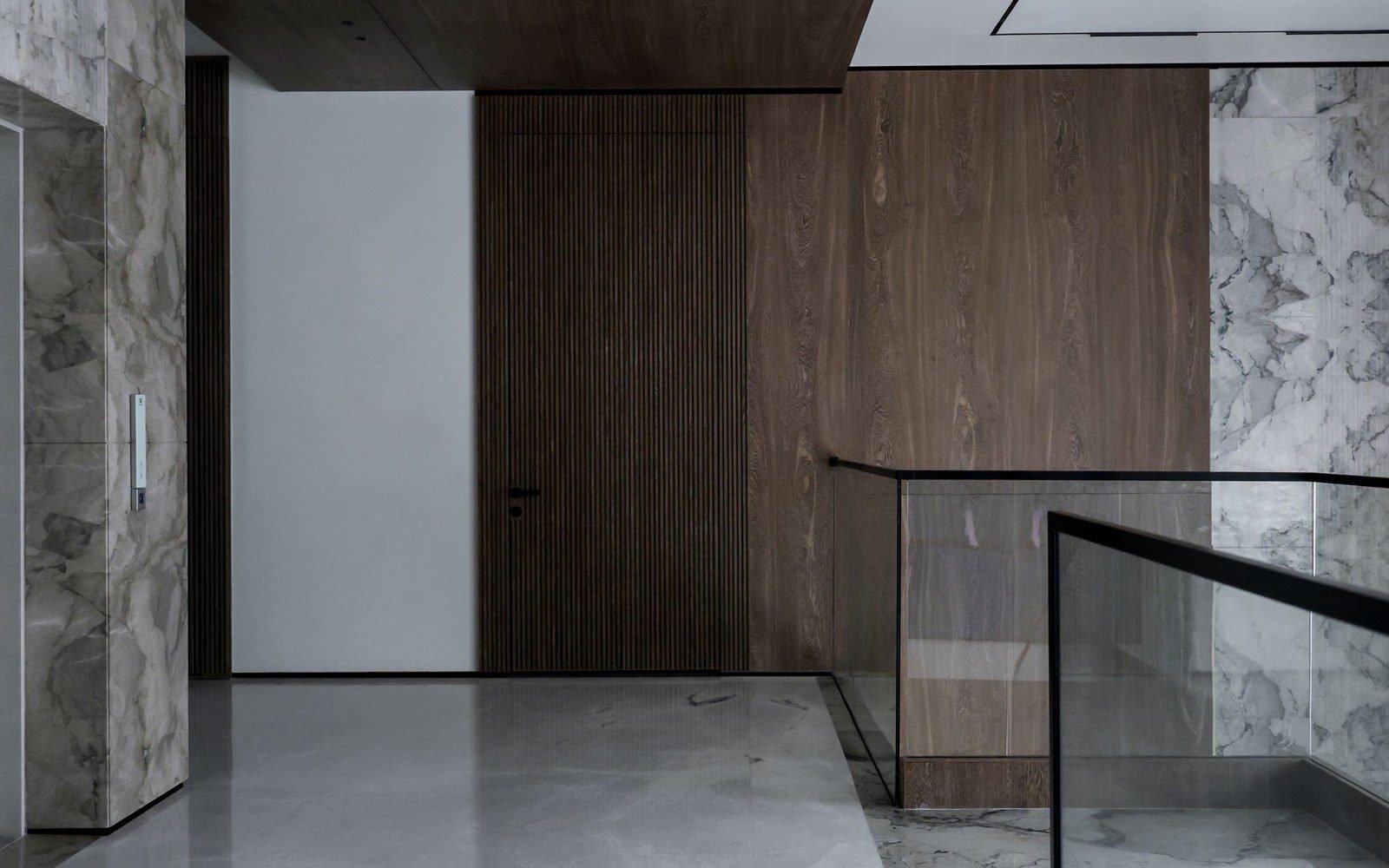
Living room and feature spaces. This is where marble earns its place. The guide’s own use-case list for marble — luxury residences, hotel lobbies, feature walls, vanities, reception areas — is the specification: a space where the design statement matters as much as the function, where the natural veining “no two slabs match” is the point, and where the owner accepts sealing and pH-neutral cleaning as the price of the look. A marble entry or a bookmatched feature wall in a living room is the classic blend the guide describes: porcelain or sintered carrying the floor area, marble taking the statement zone.
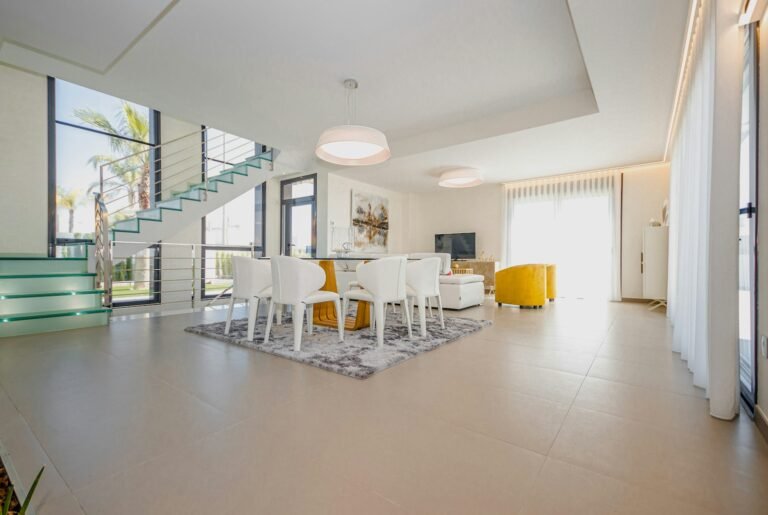
Hallways and high-traffic corridors. Traffic level is the row that decides these rooms, and the deciding tool is the PEI rating the same guide spells out: PEI 1 for a master bath with light foot traffic, PEI 3 for most residential floors including living areas and hallways, PEI 4 for residential entries and kitchens and medium-traffic commercial, PEI 5 for heavy commercial. Porcelain at PEI 4–5 is the documented winner for a hallway that sees daily traffic, because marble is “relatively soft and easily scratched by a knife” by the guide’s own words — a knife being, generously, the mild version of what a villa hallway actually meets.
Bathrooms and wet areas. Moisture exposure is the second driver. Porcelain’s impervious definition (0.5% or less absorption) “simplifies wet-area specification”; sintered stone’s ≤0.05% sits an order of magnitude below that line. Marble can serve a bathroom vanity as a feature surface — the guide lists bathroom vanities among marble’s spaces — but the floor of a daily-use bathroom is where the absorption column does the work.
Outdoor paving and pool decks. All four 2026 sources reviewed direct outdoor use to sintered stone and large-format porcelain, on three grounds: UV-stable surfaces, thermal shock resistance (sintered stone handles direct contact above 400 °C), and dimensional stability under sun and rain. None of them lists marble as an outdoor flooring choice, and that absence is the specification: in hot climates the outdoor question is not “which stone looks best” but “which surface survives the UV and the thermal cycling”, and the 2026 evidence points one direction.
Heat, humidity and UV
Our target markets make this section the one that matters most: US and Australian villas run hot and dry or hot and coastal, and Southeast Asia runs hot and humid year-round. Three mechanisms do the damage in these climates, and the table’s columns map onto them one to one.
Thermal shock is the failure mode of a material sitting in direct sun and then meeting cold water, a shaded evening, or a hot pan. The September 2026 technical guide’s numbers: sintered stone rated excellent under ISO 10545-9, tolerating direct contact above 400 °C without thermal-shock fracture, against porcelain’s “good, but sudden local temperature differences may still create cracking risk”. The same source gives sintered stone a lower linear thermal expansion (approx. 5.7–6.0 × 10⁻⁶ versus porcelain’s 7.0–8.0 × 10⁻⁶) — a slab that expands less per degree of sun has less stress to relieve at every grout line and edge.
Humidity and moisture migration is the wet-tropics mechanism: water moves through any porous surface, and what it carries — iron, tannins, acids — decides whether a stain is a mark or a chemical change. Marble’s porosity varies by variety, and the porcelain-vs-marble guide is direct that “some varieties are dense and nearly impermeable, while others absorb liquids readily and can stain”. That is not a reason to rule marble out of a villa; it is a reason to name the variety in the contract and seal it on schedule, because the maintenance column is the humidity column in disguise. Sintered stone at ≤0.05% absorption and porcelain at ≤0.5% make the mechanism largely academic, which is why both 2026 sources treat low absorption as the master indicator for stain, moisture and long-term maintenance risk.
UV stability is the long-horone mechanism: years of direct sun on the surface. The technical guide’s outdoor applications section points to sintered stone for UV-stable surface options and dimensional stability, and the porcelain slab literature in the same review round makes the identical claim for large-format porcelain. Marble is not UV-unstable in the way a polymer is, but it is the one of the three that no 2026 source puts outdoors in a hot climate — and for a villa spec that includes a pool deck, the Dubai material brief we wrote for the Middle East project (heat, humidity and material choices) is the companion reading, with the same logic applied to finishes and wall surfaces: how heat and humidity drive material selection in a hot-climate villa.

Maintenance reality
The September 2026 porcelain-vs-marble guide reduces the difference to one sentence: “Marble demands sealing and pH-neutral cleaners; porcelain doesn’t.” Expanded into a schedule a villa owner can actually run:
Marble carries three standing duties. Sealing, on a schedule set by the variety’s porosity — the dense Calacattas need it less often than the thirsty creams, which is why the variety belongs in the contract before the first slab is cut. pH-neutral cleaners only — the acidic cleaners in most household cabinets are what turn a marble floor from a surface into a maintenance project. And re-polishing, eventually: the guide’s natural-stone row notes periodic polishing maintenance for the softer minerals, and a villa’s marble will want at least one professional honed-to-polished cycle within its first decade of traffic. Add vein-matching at installation — “professional installation with careful vein-matching between pieces” is the guide’s phrasing — because the labor cost is paid once, at the wrong moment if skipped.
Sintered stone carries none of the three. The technical guide’s maintenance verdict: “usually very easy to clean, highly resistant to stains, and suitable for low-maintenance modern spaces”, with no routine sealing required — the ≤0.05% absorption is what removes the duty, not a clever cleaner. The manufacturer’s own slab data (Monalisa, 2026-08-05) pegs the abrasion resistance at PEI Grade 5 with a wear volume ≤140 mm³ against conventional ceramic’s ≤540 mm³, which is the number behind “easy to clean” in a hallway.
Porcelain sits between the two and closer to sintered: minimal sealing, easy cleaning, and a surface whose behavior “depends heavily on thickness, body structure, surface finish, and fabrication quality” — the technical guide’s warning that the name on the catalog is not the specification.
The cost of the difference, in the guide’s own 75-year life-cycle figures for light-to-medium commercial office use: porcelain at $11.38 per sq ft initial installation versus marble at $26.65, and $73.16 versus $104.03 over 75 years — annualized, $0.98 against $1.39 per square foot. Those are the maintenance-adjusted numbers, and they are the ones that should sit next to the showroom decision.
Cost per square metre
The September 2026 price guide opens with the rule that explains why online prices look inconsistent: a sintered stone price can mean three different things — the factory price of an unfinished slab, the price of a fabricated surface, or the final installed price in a local market — and comparing them without checking what is included is the main error. Its 2026 planning references:
| Market / quote type | Reference | What the number usually means |
|---|---|---|
| Factory catalog, 900×1800 mm slab (factory check, 2026-07-18) | $35–$171.60 per slab (about $21.60–$105.93/m²) | Material only — excludes fabrication, packing, freight, duties, local delivery, installation |
| United States, installed | $60–$200 per ft² | Countertop material + installation (Angi, July 2026) |
| United Kingdom, work surface | £250–£1,000 per m² (many projects around £500–£600) | Work-surface market range |
| Canada, installed | CAD $100–$200 per ft² | Installed planning range |
| Australia, benchtop | AUD $600–$1,400 per m² | Cited in an Australian government impact statement |
Two rows do the comparison work for a villa floor. The porcelain-vs-marble guide’s office-installation figures (porcelain $11.38 vs marble $26.65 per sq ft initial) are the only installed-vs-installed pair in any of the four sources, and its Angi 2026 shower data (porcelain $15–$50 vs marble $20–$65 per sq ft installed) confirms the direction in a residential wet area. And the manufacturer’s own note from August 2026: sintered stone slabs carry a 15–30% higher unit price than conventional tiles, on top of which skilled fabrication is required — so “sintered stone” is not one price but a family, from through-body tile to large-format slab.
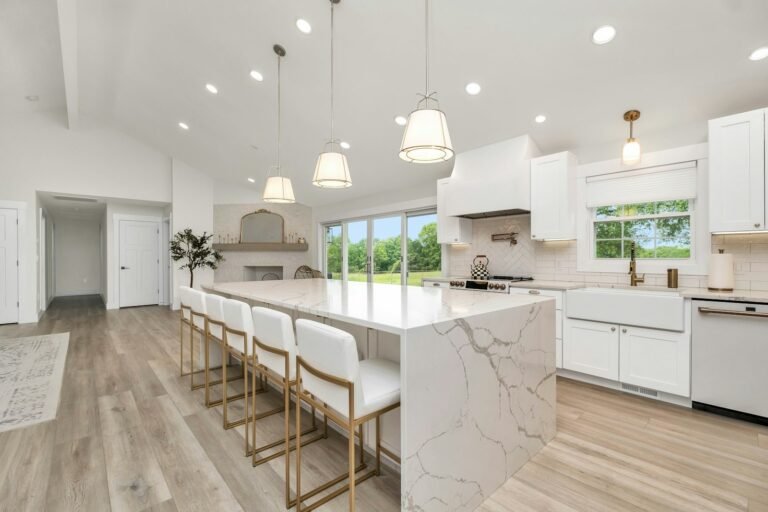
The second cost lesson from the price guide is the slab-yield problem, and it applies to marble hardest: “the project may pay for the whole slab even when the finished pieces use less area. Slab dimensions and cutting yield therefore matter as much as the nominal price per square metre.” A Calacatta slab cut into hallway runners with 40% of the book-matched veining going to offcuts is a floor whose real price per laid metre is far above the sticker. The budget line for stone in a villa project should therefore carry three numbers — material per m², cutting-yield loss, and the installation finish (vein-matched or not) — and the cost-of-a-villa-interior guide is where those three sit in the total.
How to specify it in a China order
The technical guide’s one-line instruction is the whole section: “Do not buy only by the label ‘porcelain’ or ‘sintered stone’; check thickness, body structure, water absorption, strength data, surface finish, and fabrication guidance.” In a Foshan order, that instruction becomes a working procedure:
One, order a sample slab, not a sample chip. A chip proves the color; a slab proves the body. The sample should carry the thickness, the finish, and — for marble — the veining density you are actually buying, because variety-to-variability inside the same “Carrara” is how a floor arrives different from the photo. For sintered stone, the sample is the check that the “marble-look” is the 98%-realism slab and not a thinner glazed tile wearing the same name — the label-confusion warning from both 2026 guides, and the reason the Monalisa data table exists.
Two, name the batch in the contract. Porcelain and sintered stone are “consistent within a dye lot” by the porcelain-vs-marble guide — consistent, in other words, only inside the lot. A villa floor ordered in two production runs can carry a visible tone break at the seam where run one ends, and the contract line that prevents it is the one that names the dye lot and requires any re-order to be matched to it. Marble is the mirror case: every slab is different by definition, so the contract line is the vein-matching standard instead — matched, book-matched, or free-laid — because “careful vein-matching” is a labor specification, not a material one.
Three, price the breakage allowance and the spares. Stone ships in a container, and a container is not a soft material. As factory practice — ours, stated as practice rather than as a standard — villa stone orders carry a 5–8% spare allowance: cut-offs, a few full spares per major format, and the edge pieces most likely to be the ones damaged in transit. The allowance belongs in the packing list by room, using the same room-based labelling system the flat-pack packing standard describes, so that a cracked hallway runner is replaced from the labelled spare and not from a re-order six weeks out.
Four, put the datasheet in the quotation file. The water absorption figure, the PEI rating, the flexural strength, the finish code — the rows of the table in this article, written into the quote for the exact product being priced. The two product hubs that carry the specification in the shop are the marble and stone range and the flooring and tiles range; both list the formats and finishes the way a specification should, and both are the starting point when the question is which of the three materials carries which room.
Frequently asked questions
Is sintered stone the same as marble-look porcelain?
Not necessarily — and the September 2026 technical guide is blunt that suppliers use “sintered stone”, “porcelain slab”, “large-format porcelain” and “ceramic slab” in overlapping ways, so you should not judge only by the name on a catalog. In practice the difference is density and performance: sintered stone slabs are pressed at far higher force and fire to lower absorption (≤0.05%, often around 0.02%, against porcelain’s 0.5% impervious line), with flexural strength from 45 MPa upward against porcelain’s 24–35. A thin glazed tile wearing a marble pattern is none of the three in any performance sense. The check is the datasheet — thickness, body structure, water absorption, strength data — not the label.
Which is better for outdoor flooring in a hot climate?
Sintered stone, per all four 2026 sources reviewed. The grounds are the three outdoor mechanisms: UV-stable surface options, thermal shock resistance (direct contact above 400 °C without fracture, ISO 10545-9), and lower linear thermal expansion, so the slab stresses its edges less under a full day of sun. Large-format porcelain is the accepted second direction for outdoor work. Marble is the one of the three that no 2026 source lists as an outdoor flooring choice, and in a pool-deck or courtyard spec that absence is the answer: the outdoor question is survival under UV and thermal cycling, not look.
Is marble a bad choice for a villa floor?
No — it is a choice with a schedule attached. The porcelain-vs-marble guide puts marble where the design statement matters as much as the function: feature walls, entryways, luxury living and hotel-lobby spaces, vanities. The price of that look is three standing duties: sealing on a variety-based schedule, pH-neutral cleaners only, and eventual re-polishing under traffic — and the 75-year life-cycle figures show the difference ($104.03 per sq ft against porcelain’s $73.16, annualized $1.39 against $0.98). A villa that marbles its entry and feature wall, porcelain or sintered its hallways and wet areas, and names the marble variety in the contract, is using each material where the 2026 evidence says it wins.
Which material holds up best in a high-traffic hallway?
Porcelain at PEI 4–5. The guide’s PEI scale is the tool: PEI 3 covers most residential floors including hallways, PEI 4 covers residential entries and kitchens, PEI 5 covers heavy commercial — and high-traffic flooring is exactly where “porcelain’s PEI 4–5 durability” is the guide’s own phrasing. Sintered stone’s PEI Grade 5 abrasion resistance puts it in the same tier at better absorption. Marble is the one the guide describes as “relatively soft and easily scratched by a knife” — softness that varies by quarry and variety — and it is the material to reserve for the rooms where the traffic is lighter and the statement larger.
How do I compare prices between the three materials?
Compare inclusions before you compare numbers. The September 2026 price guide’s rule: a “price” can mean factory slab material, fabricated surface, or installed local price, and mixing the three is why online ranges look inconsistent. The only installed-vs-installed pair in the reviewed sources is the office-flooring figures (porcelain $11.38 vs marble $26.65 per sq ft initial, life-cycle $73.16 vs $104.03 over 75 years), with Angi’s 2026 shower data confirming the direction (porcelain $15–$50 vs marble $20–$65 installed per sq ft). Factory-direct sintered slab runs about $21.60–$105.93/m² for 900×1800 formats, excluding everything after the gate. Remember the conversion (1 m² = 10.764 ft²) converts area only — it does not make a material-only price comparable to an installed one — and remember slab yield: for marble, the project may pay for the whole slab while the laid area uses less of it.
How should I specify stone in an order to China?
Four lines, in the contract, not the chat: (1) a sample slab — not a chip — proving thickness, finish and veining density; (2) the batch named — the dye lot for porcelain and sintered stone, so a re-order matches the laid floor, or the vein-matching standard for marble, since every slab differs by definition; (3) the breakage allowance and spares priced and packed by room, our factory practice at 5–8% for villa stone; (4) the datasheet rows — water absorption, PEI, flexural strength, finish code — written into the quotation for the exact product being priced. The two 2026 guides converge on the same closing warning: do not buy by the label, buy by the specification.
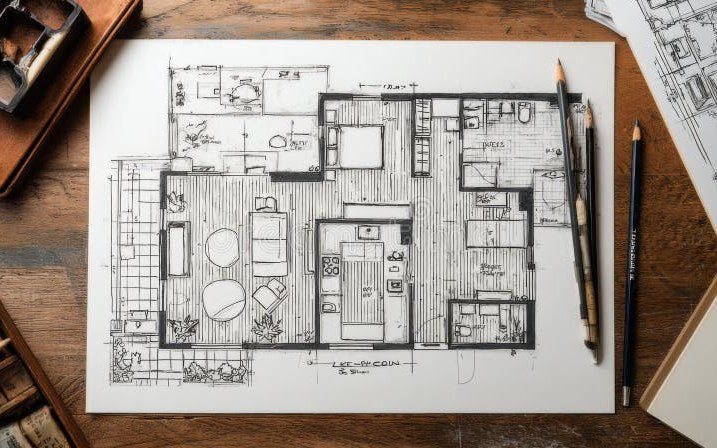
Which of the three materials should carry your villa’s floor — and do you already hold quotes to compare? Send the floor plan and the shortlist, and we will return a room-by-room specification with the batch, breakage and sample lines written in, free of charge.
The same spec discipline applies above the floor: thickness, seams, cutouts and batch for kitchen and bathroom surfaces are covered in our sintered stone vs quartz vs marble countertop guide.