Hotel and Resort FF&E from China: Procurement Sequence and Timelines
FF&E procurement is where hotel projects either hold their opening date or lose it, because the furniture is the longest lead time the operator can see. If you are evaluating a hotel furniture supplier in China for a resort or boutique hotel, the question that matters most is not “what does it cost” but “what is the sequence” — because the sequence decides everything downstream: what gets approved, when production starts, and whether fifty identical rooms arrive matching. The short version: scope the FF&E against the OS&E boundary, build one or two mock-up rooms and get them signed off in writing, then release the remaining room types to production in batches, with fabric and fire-test evidence attached to every item, all of it scheduled backwards from the opening day.
What FF&E Covers in a Hospitality Project
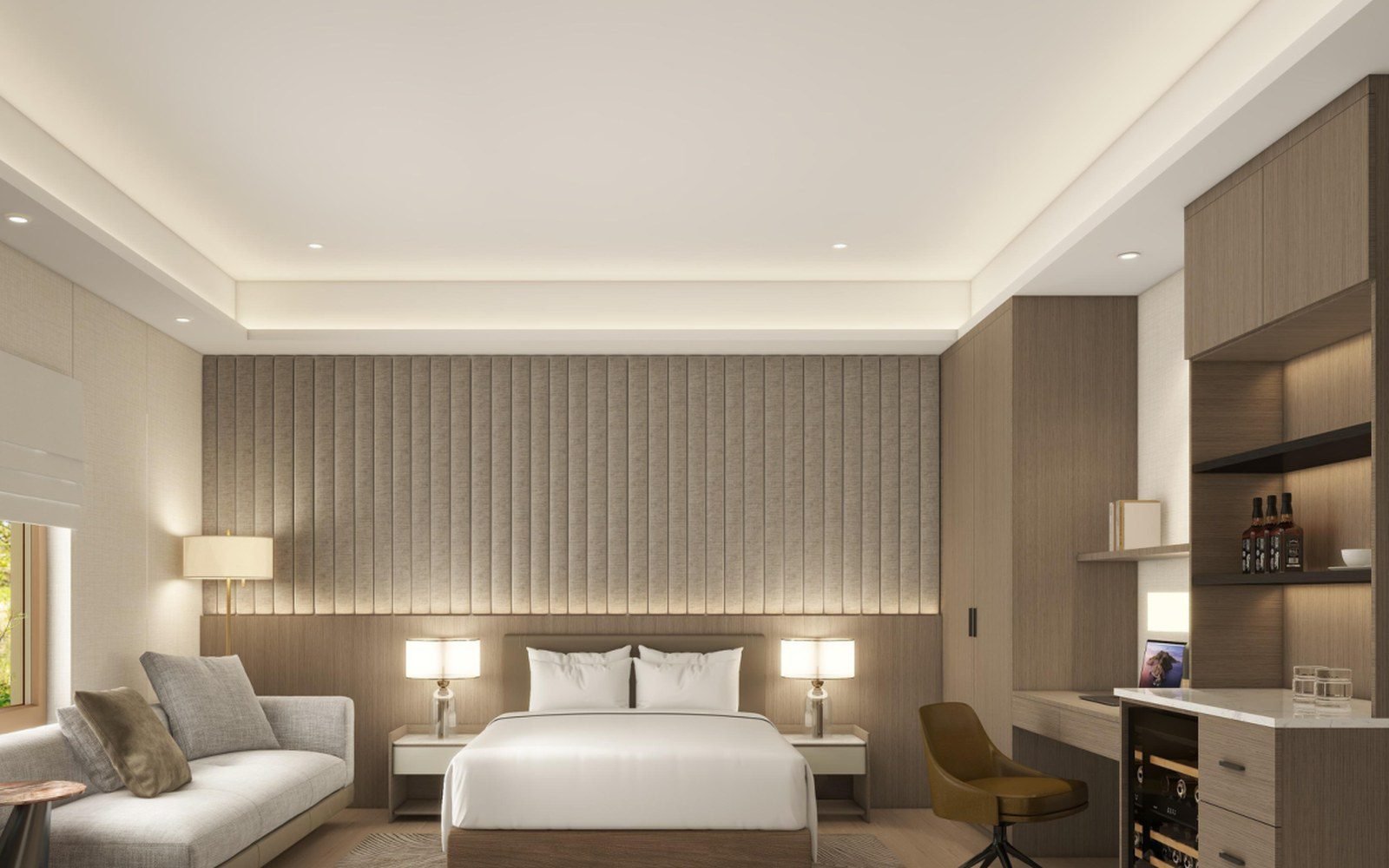
The industry splits hotel procurement into two budgets, and the split is the first thing a factory needs to understand before it quotes. FF&E — fixtures, furnishings and equipment — is the furniture and fit-out the guest actually touches: guest room beds, wardrobes and desks, lounge seating, dining furniture, reception desks, bar counters, lighting, artwork, mirrors and casegoods. OS&E — operating supplies — is the consumable layer on top of it: linens, towels, amenities, glassware, room-service trolleys, cleaning equipment. The boundary is permanence and replacement cycle: FF&E is specified, approved and installed once, and OS&E is re-ordered on a schedule. The practical consequence for a hotel furniture supplier in China is scope: the quote you receive covers the FF&E layer, and anything an operator lists as “the towels” or “the minibar stock” belongs in a different conversation and a different price list.
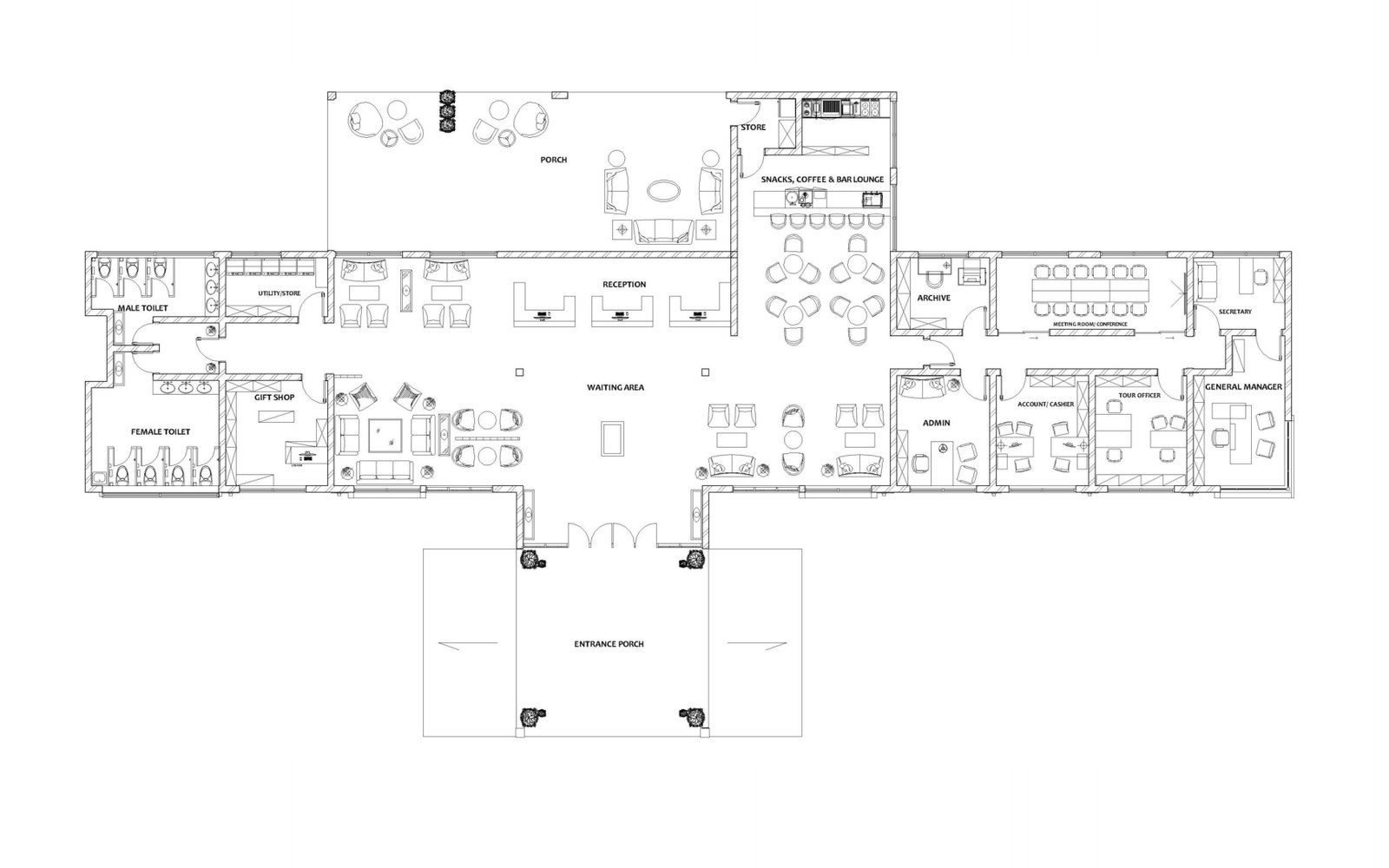
That distinction also separates hospitality projects from villa and apartment turnkey work, which is usually one owner, one residence, one set of rooms (what whole-house customization actually includes). A 50-room resort is not fifty copies of one villa; it is a small production plant with a brand standard, a room-key plan and an opening date. The reception floor plan above is a first-party example of the scope boundary in action: the furniture package covers the reception desks, the waiting area, the gift shop, the meeting room, the bar lounge and the porches, while the store shelves, the kitchen equipment and the operating supplies sit outside it. Getting that boundary wrong in the spec sheet is the most common reason a hospitality quote comes back “too high” or “too low” — and it is the cheapest mistake to make before signing anything.
The Sequence: Mock-Up First
Almost every hotel project, from a ten-room boutique to a resort village, builds one or two mock-up rooms before the bulk order is released, and the mock-up exists for one reason: it is the procurement risk filter. A rendering is an opinion; a built room is evidence. In the mock-up, the operator and the designer check the furniture against the real light, the real floor levels, the real door widths — and against the brand standard, which in branded hotels is a documented prototype that the chain’s corporate team must approve before any guest room is produced at scale.
The sequence that works is this. First, the factory produces the mock-up room’s furniture — typically one guest room and one public space — and installs it, or delivers it to the site for local installation. Second, the operator walks the room with a checklist: dimensions against the drawings, fabric colour under lobby lighting, hardware operation, joinery quality, packaging condition. Third, the approval is written down: a signed change order or an email that names what was approved and what was not. Fourth, only then is the remaining quantity released to production, usually in the room batches the operator can receive. Skipping any of these four steps is the classic failure: a resort that ordered all rooms on the strength of a rendering, received them, and found the cushion colour wrong under the real lighting — at which point the fix is a re-order, not a repaint, and the opening date has already slipped.
Two timing notes are worth keeping. The mock-up room and the standard room production are not strictly serial: once the mock-up is approved, the standard room types move to production immediately, and the only items that wait are the ones whose design changed in the mock-up. Planners who treat FF&E as a single monolithic order instead of a mock-up plus a batched release end up with a longer total lead time than the work actually requires.
Batch Consistency Across Fifty Rooms
The difference between a villa order and a hotel order is not the catalogue; it is the repetition. Fifty rooms of the same type means fifty headboards in the same veneer, fifty wardrobes with the same handle torque, fifty beds with the same upholstered panel — and the guest’s eye is trained to notice the room that is one shade different from the room next door. Consistency at that scale is managed in three places.
The first is the material batch. Veneers, laminates and fabrics are produced in batches, and two batches of “the same” colour are the same the way two years of paint from the same brand are the same: close, and visibly different side by side. The control is to specify the material lot and to buy the lot for the whole project, or to hold the remainder in stock for the touch-up order — which is why the final room batch is always kept slightly larger than the final room count. The second is numbering. Every piece in every room carries its room number and its position in the room, the same numbering system we use for villa interiors (how villa interiors are numbered, pre-drilled and packed), which means a missing or damaged piece in room 214 can be identified, replaced and re-pinned to the room without opening a single other carton. The third is packing by room, not by product: each room’s complete FF&E ships as its own set of crates, so the site receives “room 201” as a unit, installs it as a unit, and signs for it as a unit (why we pack by room).
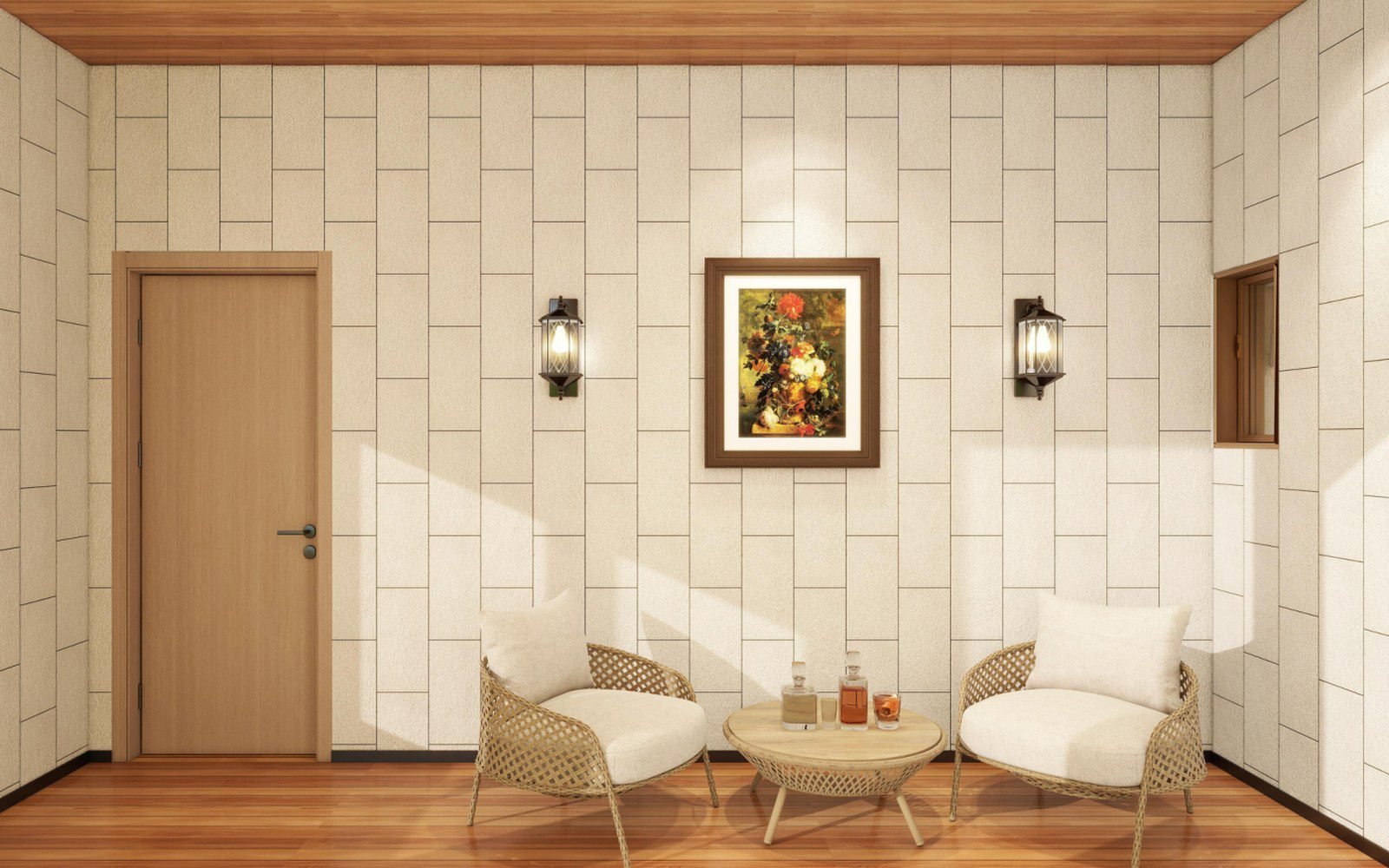
Room-type variety compounds the problem, which is why a real resort schedule is never one room type: the example project above runs standard double chalets, family lodges, club chalets, executive suites, a presidential suite and bungalow blocks 201 through 210 in the same order. The numbering and room-packing system is what makes seven room types behave like one; without it, a 50-room delivery becomes a 50-room sorting project at the site, in the wrong month, under installation pressure.
Materials That Survive Hotel Use
A guest room is used harder than any residential space the same furniture would see in a house, and the specification reflects that in two places: the fabric and the fire behaviour. On fabric, the contract-textile industry publishes its own durability tiers: the general contract standard is 15,000 double rubs on the Wyzenbeek test (ASTM D4157) or 20,000 cycles on Martindale (ASTM D4966), and the heavy-duty tier — the one a busy hotel headboard, sofa or chair actually wants — is 30,000 Wyzenbeek or 40,000 Martindale. Those are not marketing numbers; they are the figures the Association of Contract Textiles uses to classify upholstery fabric, and a hospitality furniture manufacturer should be able to quote the rub count of every fabric in the spec sheet, not just promise “hotel grade.”
On fire behaviour, the requirements are jurisdiction-specific and they are test certificates, not opinions. For the US market, the commonly cited set runs California TB 117 for upholstered furniture, CAL 133 / 16 CFR 1633 for smoking materials, NFPA 701 for drapery and other soft furnishings, and BIFMA X5.4 for furniture flammability; European and Middle East projects reference their own equivalents, and a hotel furniture supplier in China that ships to more than one region keeps the certificate file per destination. Cleanability sits underneath both: a hotel fabric has to survive repeated professional cleaning, a hotel finish has to survive trolley wheels, luggage tags and the daily wipe-down, and the spec sheet that names the test method and the standard for each of those is the spec sheet that survives a dispute.
The honest framing is that “hotel grade” is a claim until the tests are attached. A factory that can send the Wyzenbeek or Martindale result for the chosen fabric, the fire-test certificate for the chosen market, and the finish-wear note for the high-touch surfaces has done the work; a factory that answers “it’s hotel standard” without the documents has not.
Timelines: Working Backwards from Opening Day
The planner-side advice on resort FF&E procurement is consistent: start six to eight months before opening for a fit-out of an existing building, and twelve to eighteen months before for new builds and full renovations, because custom pieces, imported furniture, brand approvals and the mock-up room all stretch the chain. The second piece of consistent advice is uglier and truer: procurement lead times run longer than assumed, on every project, and the schedule that survives is the one built backwards from the opening date with the installation month, the sea-freight month and the production month each claimed first.
| Phase | What happens | The gate |
|---|---|---|
| Scope | FF&E vs OS&E boundary fixed per room type | Signed spec sheet |
| Mock-up | One or two rooms built and installed | Written operator approval |
| Production | Remaining rooms released in batches | Batch material lot held |
| Freight | Full container loads by room batch | Sea freight timeline |
| Installation | Local team installs room by room | Local installation handover |
| Acceptance | Room-by-room sign-off against the schedule | Opening-date buffer intact |
The overlap that saves weeks is the one the mock-up step creates: while the mock-up is being approved, the standard room types that the mock-up did not change are already cutting and building, so the approval signature converts into a production release rather than a production start. The overlap that costs months is the one that happens when the opening date moves and nobody re-bases the schedule: freight bookings, production slots and installation crews are all reserved against the old date, and each of them has to be renegotiated. A two-week schedule review at the midpoint of production is cheap insurance for both.
What a Hotel Furniture Supplier Should Show You Before You Order
The vendor side of the sequence is a short checklist, and every item on it is evidence rather than description. A hospitality furniture manufacturer in China that has actually shipped hotel projects will show, on request: the mock-up or sample record — photos and the written approval it produced, not just the photos; the material lot practice — how a 50-room veneer or fabric batch is reserved and held; the test file — Wyzenbeek or Martindale results for the fabrics in the spec, fire certificates for the destination market; the numbering and packing scheme — a real packing list with room numbers on it; and the reference project at the destination scale, a resort or hotel of similar room count and room-type variety. Our own commercial record spans hotels, resorts, restaurants, bars and visitor centres across West Africa, East Africa, the Indian Ocean, the Caribbean and the United States, and those projects are listed in the project index — the destination, the room count and the room types, which is exactly the evidence layer a buyer should be able to demand from any supplier before the order is released.
The order itself has one structural feature worth checking before signing: the batch split. The contract should release the rooms in the same batches the freight plan ships them, with the mock-up approval as the trigger for the first production release, and the acceptance per room batch rather than per container. That single clause is the difference between a schedule the factory can hold and a schedule the factory merely hopes to hold.
What We Need From the Operator and Designer
The buyer-side package for boutique hotel furniture is four documents, and the sequence stops for the thinnest one. First, the spec sheet: every item, every room type, with the FF&E/OS&E boundary already fixed, fabric and finish named, and the test standards named where the destination requires them. Second, the mock-up approval: the written sign-off that converts the sample room into the production standard. Third, the room-key plan: the room numbers and the room types they carry, because that is what the numbering, the packing and the site installation all key off. Fourth, the opening date — the real one, with the installation month claimed against it. A designer who delivers those four documents gets a schedule; an operator who delivers two of them gets a quote.
On measurement, the responsibility split is the same as on villa projects: the factory builds to the dimensions in the approved drawings, and the local team verifies the site before installation (working with local builders and installers). For a hotel, that verification runs per room batch, because the opening date does not wait for the slowest room.
Frequently Asked Questions
What is the MOQ for a hotel or resort project?
There is no room-count minimum for the factory; the practical minimum is one complete room type. The economics work per batch: a single mock-up room is produced at sample economics, and the order becomes efficient when the second and third batches follow the approved room. A boutique hotel of ten rooms and a resort of one hundred run the same sequence, just at different batch sizes.
Who pays for the mock-up room?
It depends on the contract structure, and both patterns are standard: the mock-up is either billed at sample price and credited against the bulk order once it is approved, or priced into the project as a non-refundable development cost. What is not standard is a mock-up that is never written up — the approval document is the point of the room, and the contract should name who signs it and what it releases.
How do you guarantee consistency across fifty identical rooms?
Three controls: the material lot is reserved for the whole project or held for touch-ups, every piece is numbered to its room and position, and every room ships as its own packed set. The lot reservation is the one buyers most often skip and the one that causes the visible colour shift between room batches — it is worth a line in the contract.
How do you meet hotel fire-retardancy requirements?
Per destination, with the test certificate attached to the spec: the US set runs TB 117, CAL 133 / 16 CFR 1633, NFPA 701 and BIFMA X5.4, and other regions carry their own standards. A supplier that names the standard and sends the certificate for the exact fabric and finish specified has met the requirement; one that says “fireproof” without the document has not.
How long is the lead time for a hotel FF&E order?
It is the sum of the sequence, not a single number: mock-up build and approval first, then production in batches, then freight and installation. Planners start procurement six to eight months before opening for fit-outs and twelve to eighteen months for new builds, and the schedule is built backwards from the opening date, because the freight and installation months have to be claimed first.
How do you deliver a multi-country resort in batches?
Room batches ship as full or partial containers keyed to the room numbers, in the order the site installs them, with each delivery carrying its own packing list and acceptance sheet. The room-key plan is the contract between the factory and the site: what is numbered is what is packed, what is packed is what is installed, and what is installed is what is signed for.