Dubai Luxury Villa: Heat, Humidity and Material Choices for Middle East Projects
This is a case study, not a trend article: a four-storey Dubai villa from our Middle East design portfolio — ground floor, first floor and a roof-floor family sitting, with a 5,500 × 6,100 mm kitchen and a covered outdoor kitchen — read as a document about climate. Every material decision in the package is a response to the same three numbers: a July mean daily maximum of 41.7 °C, an ultraviolet index that sits at 12 (the “extreme” band) from May through August, and 3,570 hours of sunshine per year. The climate data below comes from the Dubai Meteorological Office and NOAA 1991–2020 normals; the material performance figures from a July 2026 fifteen-criteria stone comparison; and the rooms from the villa’s own 110-page design package, so every image in this post is of the actual case.
The conclusion for buyers specifying villas in the Gulf: the climate is not a footnote to the design, it is the first spec sheet. Stone is zoned by exposure (sintered where the sun and the cooktop reach, marble where the AC holds), board grades follow the humidity cycle instead of taste, the finish palette runs light to reject radiant heat, and the two rooms that prove the whole thesis — the outdoor kitchen and the rooftop sitting room — are standard fit-outs in the region, not extras.
In This Guide
The climate is the first spec sheet
Dubai’s summer runs roughly from the last week of April to the first week of October, and it is a specific kind of hot: the mean daily maximum climbs to 41.7 °C in July and 42.1 °C in August, the city’s recorded high reached 50.1 °C in July 2023, and overnight lows in the peak months barely drop below 30 °C. The sun does the rest — a UV index of 12 through the summer months and 3,570 sunshine hours a year, which is more UV dose on the same surfaces than any villa in Northern Europe or North America will ever see. Humidity adds the other half of the problem: summer dew points sit around 26.5 °C near the coast, and the winter that feels pleasant (24 °C days, 14 °C nights in January) is also when the air carries 65% relative humidity — so the interior lives through a hot-humid season and a cool-humid one, with almost no dry, stable season in between. Wind-driven dust storms in the summer add the third stress: dust works into every joint, gap and ventilation opening the design allows.
That combination — UV dose, dew-point humidity and dust — is what a material schedule has to answer, and it answers it in four ways. Surfaces that sit in direct sun need UV-stable colour, full stop; boards need a moisture grade that matches the wettest month, not the average; joints and clearances need to be wide enough for thermal movement and narrow enough to shed dust; and the palette, at least in the volumes that the sun reads through, runs light. Every section below is one of those four answers applied to the rooms of this villa.
What the Dubai villa actually uses
The villa’s interior language is deliberately light: large-format white marble carries the floors, the stair, the feature wall of the family sitting and most of the bathroom surfaces, warmed by light-oak slat panelling, taupe and grey upholstery, and black steel-framed glass at the openings. Light stone on the floor is not a style choice first — it is a thermal one. Pale, low-vein marble reflects the radiant load of a Gulf summer instead of absorbing it, which is why the palette never drops to dark stone in the sun-exposed volumes.

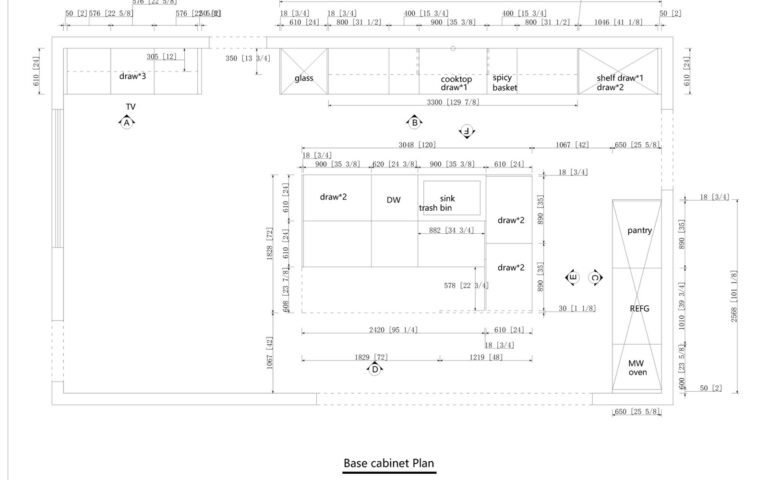
The kitchen — 5,500 × 6,100 mm on the ground floor — opens onto a covered outdoor kitchen, and that outdoor zone is where the climate argument gets its sharpest edges: a stone-topped cooking run with a grill and built-in oven under a slatted timber soffit, set on marble paving under an open sky. The rooftop family sitting repeats the same logic at scale: the hottest volume in the house, so the lightest palette in the house, with the ceiling treatment and glass doing the shading work.

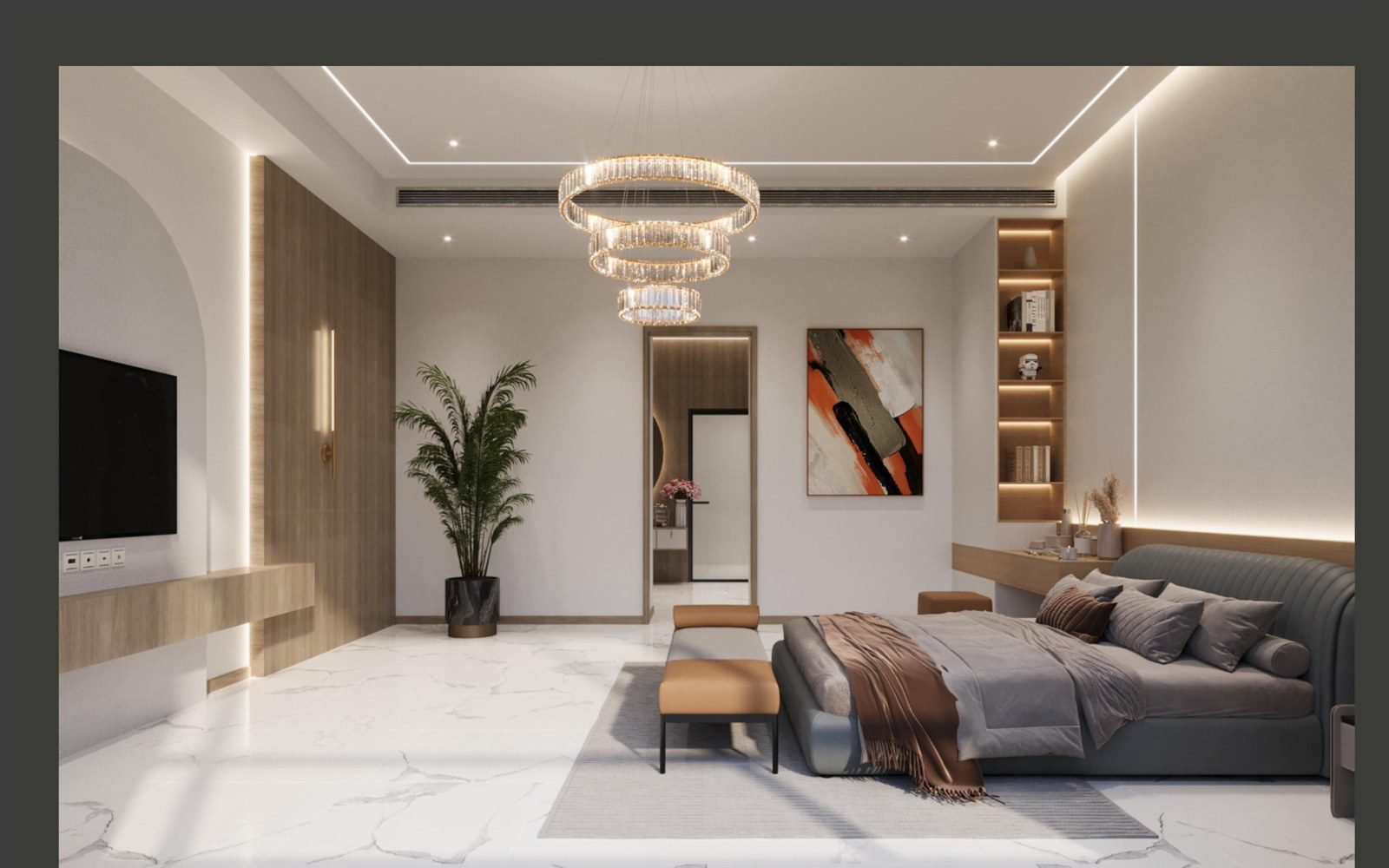
The bedrooms hold the palette closest to the rest of the world’s villa design — chandelier, bed, art, a TV wall — because the AC holds the room and the sun never reaches the surfaces. The material difference between a Dubai bedroom and a Doha one and a Riyadh one is smaller than the difference between any of them and their own outdoor kitchen, which is the point: in the Gulf the interior is an engineered climate, and the exterior-facing zones are where the specification has to earn its keep.
Stone: where the climate picks the material
The 2026 fifteen-criteria comparison of the three working stone families draws the zoning line precisely. Sintered stone takes direct hot cookware at 2,000 °F or higher with no thermal-shock risk, absorbs 0% water, shows no UV colour fade, and is rated for 50+ years of service with near-zero maintenance over three decades. Quartz is excellent indoors — but its resin binder (5–10% of the slab) yellows within one to two years of direct UV exposure and the material is rated to about 150 °F, which rules it out of sunlit runs and outdoor kitchens entirely. Marble is the statement material: 300 °F tolerant, good UV stability for an interior stone, but 2–3% porous, requiring resealing every 6–12 months, and carrying a 10-year maintenance cost of roughly $2,000–$5,000 against $0–$100 for sintered stone.
The zoning rule that falls out of those numbers is simple, and this villa follows it: sintered stone where the sun and the cooktop reach — the outdoor kitchen, sunlit counters, poolside — and marble where the AC holds — the great rooms, the stair, the baths — with the maintenance cost of the marble accepted deliberately, because the natural veining is the reason the room photographs as luxury at all. When a quote for a Gulf kitchen shows one stone family for every surface, that is the first line to question; the kitchen cost guide makes the same point from the pricing side, where stone fabrication is the line that hides the most money.
Boards, lacquer and the humidity cycle
The board rule for the Gulf follows the dew point, not the average temperature. In the wet row — sink, dishwasher, pool-adjacent and outdoor-adjacent units — the carcass is specified in high-moisture-resistance board or marine-grade plywood, exactly as the kitchen guide prescribes for humid destinations; the Gulf is that humid destination at its maximum. In the dry interior rows, standard moisture-resistant board is sufficient, and the real risk is not swelling but the other half of the cycle: a 26.5 °C summer dew point against an air-conditioned room at 22 °C is a daily condensation swing that attacks glue lines and finishes more than it attacks board.
That is why the finish specification carries two Gulf-specific lines. The first is UV-stable pigment in the lacquer: a matte colour system that holds under a UV index of 12 without the grey shift that hits non-rated pigments within a couple of summers — the finishing comparison ranks the systems, and for Gulf sunlit rooms the UV rating of the pigment is the deciding column. The second is the solid-wood rule from the contract guide: where solid wood is in the package, the 10% retention held for 30–60 days after delivery exists precisely for this climate, because that is the window in which summer movement shows itself. Dust closes the loop on hardware: the pull-out and hinge families are specified with sealed runners, and the joint clearances on the drawings are set for dust, which is why the pre-shipment inspection checks fittings and clearances, not just surfaces.
The outdoor kitchen and the rooftop: the two rooms that prove the thesis
The outdoor kitchen is the room where every stress in this article happens at once — UV index 12, 40+ °C ambient, heat load from the cooktop, dust, and the occasional summer storm — and the specification answers each one: sintered stone on every horizontal surface, UV-rated hardware, a slatted timber soffit that shades the seating line without closing the volume, and a glass line set back from the cooking zone so the thermal load lands on stone, not on glass or board. In the Middle East this room is standard fit-out, not a luxury extra: the summer months are when the villa lives outside, and the outdoor kitchen is where the house is used most.
The rooftop family sitting makes the complementary point. The roof volume is the hottest space in a Gulf villa, and the package answers it with the lightest palette in the house, a full-height glass line with shading, and furniture specified for an outdoor-adjacent duty cycle. Buyers comparing Gulf villas to Northern projects usually miss both rooms in their specification, and then pay for them as change orders — which is exactly the dynamic the contract guide is built to prevent, with both rooms on the annex list before the deposit, not after.
Specifying for the Gulf: the short checklist
| Climate stress | The material answer | Where it lands in the package |
|---|---|---|
| UV index 12, 3,570 h sun/yr | UV-stable pigment; sintered stone in sun | Lacquer spec, outdoor kitchen, poolside |
| 41.7 °C July mean max, 50.1 °C record | Light palette; thermal-clearance joints | Rooftop, sun-exposed volumes |
| 26.5 °C summer dew point | HMR/marine board in wet rows; 10% solid-wood retention | Carcass spec, contract clause |
| 65% RH even in winter | Sealed glue lines, condensation-rated finishes | Interior rows, baths |
| Summer dust storms | Sealed runners, dust-set joint clearances | Hardware families, drawings |
| Outdoor summer living | Covered outdoor kitchen, roof-level sitting | Standard fit-out scope |
The checklist is the same pattern the rest of the villa follows: every climate stress maps to a written line, and every written line has a checkpoint — the 48-hour design confirmation locks the zones, the BOM carries the board and stone grades, the inspection verifies them before the container seals, and the shipping plan times the arrival so finished goods are never stored in the Gulf summer without cooling. A Middle East package that cannot show those lines is not cheaper — it is just missing the part that costs the most when the climate does its work.
Frequently asked questions
Can marble floors be used in a Dubai villa?
Yes — this villa uses large-format marble on its floors, stair and feature walls — but with the maintenance accepted deliberately: marble is 2–3% porous, needs resealing every 6–12 months, and carries a 10-year maintenance cost of roughly $2,000–$5,000 against near-zero for sintered stone. The working rule is zoning: marble where the AC holds, sintered stone where the sun, water or traffic does not.
Why not quartz in a sunlit or outdoor kitchen?
The resin binder in quartz (5–10% of the slab by weight) yellows within one to two years of direct UV exposure, and the material is heat-rated to about 150 °F, below what a cooktop run sees. In a Gulf kitchen the quartz belongs to the shaded interior islands; the sunlit and outdoor runs go to sintered stone, which shows no UV fade and takes direct hot cookware.
Which board material suits Gulf villas?
High-moisture-resistance board or marine-grade plywood in the wet row — sink, dishwasher, pool- and outdoor-adjacent units — and standard moisture-resistant board in the dry interior rows. The Gulf’s 26.5 °C summer dew point means the board grade follows the wettest month, and the condensation swing is what tests the glue lines and finishes, not the board itself.
Is an outdoor kitchen standard in Middle East villas?
It is a standard fit-out, not an upgrade: with summer running from late April to early October at 40+ °C, the outdoor kitchen is where the house is used most in the year. Specify it on the annex before the deposit — sintered stone on every horizontal surface, UV-rated hardware and a shaded seating line — or pay for it later as a change order.
How does dust affect fitted interiors?
Dust storms load every joint and gap the design allows, so the specification answers it in two places: sealed hardware runners on the pull-out families, and joint clearances set on the drawings for dust rather than the tightest possible line. Both are checked at pre-shipment inspection, because dust problems show up as squeaks and binds months after installation.
When should a Gulf villa package be delivered?
Time the arrival so finished goods are not stored in uncooled conditions through the Gulf summer: production and shipping are scheduled against the site’s cooling-ready date, and the container plan in the shipping guide holds the sequence. Where the site is not ready, the 10% retention period in the contract is when the summer movement gets its honest look.
Send us the Gulf project — floor plan and climate, that is all we need to start — and we will return the material schedule: stone zoned by exposure, board grades by dew point, UV-rated finishes and the outdoor scope, checked against the drawings before the first panel is cut.