
LCL vs FCL for Villa Interior Exports: Which One Saves You Money
For most villa interior projects, the answer is the same: ship FCL (a full container) once your package exceeds roughly 10–15 cubic metres of packed volume, and keep LCL (less-than-container load) for samples, single small rooms and late add-on orders. Below that threshold, LCL is usually the cheaper and more flexible option; above it, the per-cubic-metre math flips, and a full container — with fewer handoffs and full control of the seal — becomes both the cheaper and the safer way to move a fragile, high-value interior. The exact crossover depends on the lane and the freight market, but the 10–15 m³ band is where industry freight guidance consistently puts the switch point, and villa packages almost always sit on the FCL side of it.
This guide explains how LCL and FCL are priced differently, where the cost crossover lands, how the extra handling on LCL affects fragile furniture, and how to decide for a villa project — including the hybrid approach we use for samples and reorders. It pairs naturally with our shipping guide and the wider villa interiors sourcing workflow.

In This Guide
What LCL and FCL actually mean
LCL means your cargo shares a container with other shippers’ cargo. It is collected at a container freight station (CFS), consolidated with other consignments, and deconsolidated at the destination CFS before delivery. FCL means you charter the whole container: it is loaded at your factory, sealed, and moved directly to the destination without being opened for anyone else.
The pricing model is different in each case. LCL is charged per cubic metre or per tonne, whichever is greater, plus origin and destination CFS handling charges. FCL is charged as one flat rate per container, no matter how full it is inside that limit. That single difference — per-cube pricing versus flat pricing — is the whole reason the crossover exists, and it is the first thing to understand before comparing any two quotes.
| Container | Approx. usable volume | Approx. max payload | Typical villa fit |
|---|---|---|---|
| 20GP | 28–33 m³ | 21–28 t | A large kitchen plus joinery, or two medium rooms |
| 40GP | ~59–67 m³ | 26–28 t | A full villa interior package on one shipment |
| 40HC | ~68–76 m³ | 26–28 t | A full package with taller units or loose-fitting crates |
The volume figures are planning approximations from standard container specifications; actual loadable volume depends on crate shapes and how tightly the package stacks, which is why we always plan against the packed volume from the production list, not the furniture’s footprint on the drawings.
The crossover point: where FCL gets cheaper
Freight guidance puts the switch in the same band repeatedly: when an LCL shipment reaches around 15 cubic metres, it is time to start pricing a full container, and a full container becomes cheaper per cubic metre above roughly that volume once CFS and handling fees are included. A second rule of thumb from the furniture trade: move to FCL when the LCL quote climbs to about 60–70% of the full-container price for the same lane, because the last third of the container is effectively the part you are overpaying for under LCL.
For villa interiors, this mostly resolves itself. A single kitchen, flat-packed in numbered crates, commonly occupies the 8–15 m³ range — genuinely close to the crossover, where either option can win and the lane price decides. A full villa package — kitchen, wardrobes, joinery and finishing pieces — routinely reaches several times a 20GP’s volume, which puts it firmly in FCL territory, often spread across one or more 40GP/40HC containers. Because FCL is flat-priced, filling the container is free margin: every extra crate of wardrobes that fits is volume you did not pay for per-cube. The honest version of the calculation is: compare your LCL per-cube rate times your packed volume, plus CFS charges, against the FCL flat rate for the lane — and the BOM is what tells you the packed volume in the first place, because it is where the part counts and materials that become crates are itemised.
Handling, damage and control
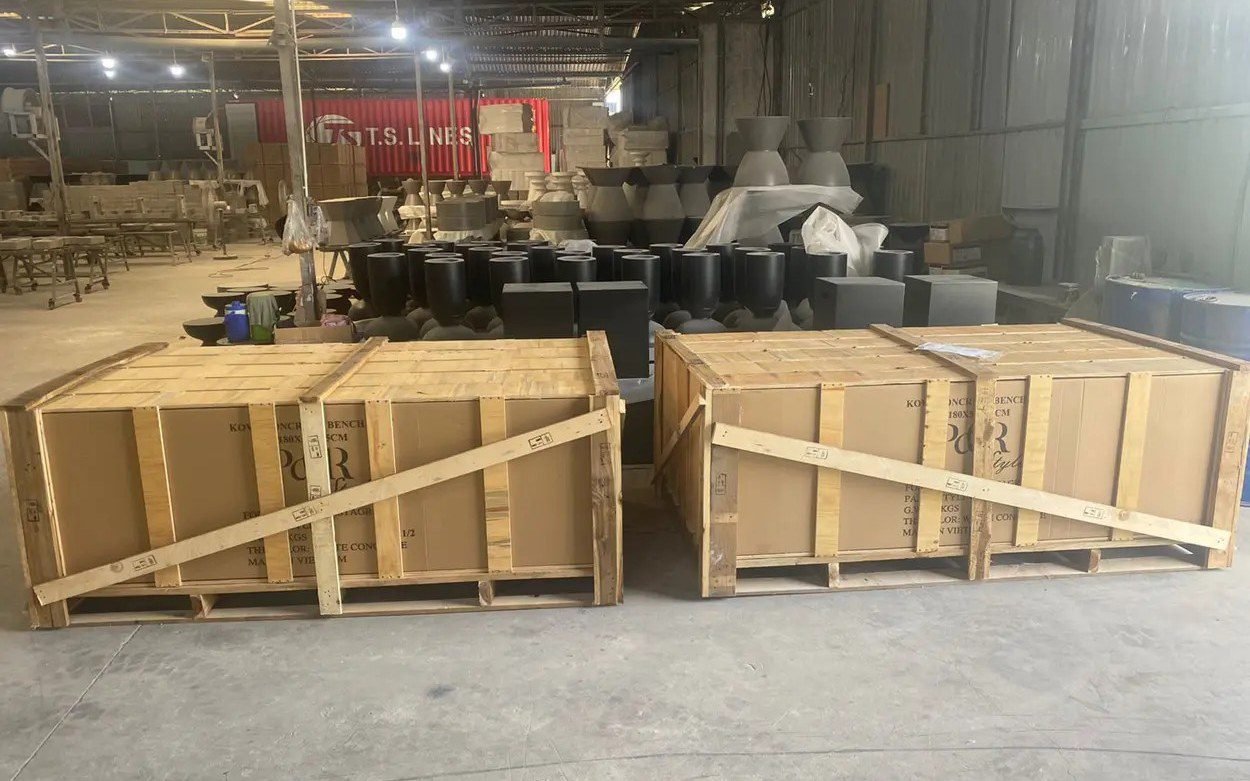
Furniture is one of the more unforgiving cargoes for LCL. On an FCL booking, your crates go from the factory floor into a container you seal, and that seal stays on until the destination opens it. On LCL, the same crates are offloaded from the first truck, sorted at the CFS, loaded into a shared container with other people’s cargo — which can include heavier, harder items stacked around or on top of soft goods — and repeated in reverse at the other end. Every one of those handoffs is a chance for scuffs, dents and crushed crate corners.
That matters more for villa interiors than for most consumer goods, for two reasons. First, the value per crate is high: a single wardrobe section or an island with its finish on is a meaningful sum. Second, the crates are numbered and pre-drilled — the same numbering that makes installation fast also means that a damaged part is not swappable with an identical one from a batch; it is a specific numbered component that may need a replacement run. For most villa projects we therefore treat FCL as the default and LCL as the exception for small volumes, and we spec the packing to survive the handling each option actually involves.
Transit time and scheduling
LCL adds days to the crossing, not because the ship is slower but because the consolidation process is. At the origin, your cargo waits for the CFS cut-off and for the consolidation to be complete; at the destination, it waits again while the container is broken down and your part is sorted out. On a long island or regional route that can add a week or more end-to-end, on top of the vessel schedule.
For a villa, transit time is not an abstract cost — it sits directly against the building schedule, as our Fiji island package case worked through in detail: the interior should arrive when the shell is ready for it, not a month early and not a month late. FCL gives you one clean, predictable milestone (container loaded, date known, transit known) that is easy to build a handover plan around. LCL gives you a milestone plus two consolidation waits that depend partly on other people’s cargo. When the project has a fixed handover date, that predictability is worth real money.
Insurance and claims
Insurance follows the same logic as damage risk. On FCL, the entire container is yours, the seal is yours, and if something goes wrong the story is simple: one container, one owner of the cargo, one point to check the seal at each handoff. On LCL, your crates travel mixed with other shippers’ cargo, which complicates both the risk and any claim. If a part arrives damaged, establishing what happened, where it happened, and that it was your part versus a similar-looking one from another consignment takes longer, and shared-cargo claims are historically the slower kind to resolve.
This is one of the quiet reasons the switch point for high-value furniture sits lower than the pure price math suggests. A villa interior is not a commodity pallet; it is a set of unique, numbered, finish-applied components. The extra protection of a sealed, dedicated container is doing double duty — lowering the probability of damage and keeping the claim path short if damage happens anyway.
What to choose for a villa project
| Your order | Recommended | Why |
|---|---|---|
| Pre-production samples / door samples | LCL | Small volume, speed and flexibility matter more than per-cube cost |
| A single small kitchen (below ~10 m³) | LCL, priced against FCL | Genuinely below the crossover — compare both quotes |
| A full kitchen in the 10–15 m³ band | Quote both, default to FCL on tight schedules | At the crossover; FCL also removes consolidation handling |
| A full villa package (multiple rooms) | FCL, one or more 40GP/40HC | Far above the crossover; flat pricing + sealed container |
| Late add-ons or replacements | LCL if small, FCL top-up if the container is not yet loaded | Chase the volume, but only until the container is sealed |
Two practical notes. First, the decision should be made from the packed volume the BOM produces, not from a feel for the project size — the itemised parts list is what converts a design into cubic metres. Second, the hybrid pattern is normal and worth planning for: sample order by LCL, main package by FCL, and any small add-ons that are ready before the container loads simply join it, since FCL pricing is flat. Our FAQ covers the logistics questions clients ask most often once the booking stage begins.

Frequently asked questions
Is LCL ever cheaper than FCL for furniture?
Yes — below roughly 10 cubic metres of packed volume, LCL is usually the cheaper option, because you only pay for the space your crates take. The crossover band is around 10–15 m³, after which FCL typically wins on price as well as handling.
How is LCL shipping charged?
Per cubic metre or per tonne, whichever is greater, plus container freight station (CFS) handling charges at both ends. The per-cube rate is set by the consolidator and moves with the freight market, which is why the same volume can cost very differently month to month.
What is the difference between a 40GP and a 40HC?
The high-cube (40HC) is about a foot taller inside, giving roughly 76 m³ versus 60–67 m³ for a standard 40GP. Villa packages with tall units, island pieces or loosely stacked crates usually get more usable space from a 40HC for a similar rate.
Can I mix LCL and FCL in one project?
Yes, and it is common: samples by LCL before production, the main package by FCL, and small add-ons by LCL afterwards. The only thing to avoid is splitting one tightly coordinated room across two shipments, because the install schedule gets harder to keep.
Does FCL take the same time as LCL on the water?
The vessel transit is the same route, but LCL adds consolidation waits at both ends, so the total door-to-door time is usually longer — sometimes by a week or more on longer routes.
How do I find out what volume my villa package will be?
From the BOM and the packing plan: the itemised parts, once flat-packed into numbered crates, give a real packed volume. Ask your supplier for the estimated CBM per container before you compare LCL and FCL quotes, since that number is what the quotes are built from.





3 Comments