Furniture Supplier in China: How to Shortlist Without a Showroom Visit
Most buyers treat a furniture supplier in China as a search problem. Pull up a marketplace, collect twenty or thirty names, and hope the best one surfaces on its own. It does not. A shortlist that is not built deliberately carries you to a trading company with a rented showroom, or to a factory that passes the photograph test and fails the production test. The useful fact is that a large share of due diligence can be done remotely, before you pay for a flight or invite anyone onto a factory floor. This guide sets out the funnel that takes a long list of names down to two or three you can actually risk money with, step by step, and marks the point where a visit finally becomes worth its cost.
The funnel has five stages: narrow the search pool, verify the legal entity, run the documentation test, do a remote video audit, and test a sample. Each stage removes candidates, and each one has a specific document or a specific camera shot that proves or disproves the claim in front of you. Work the stages in order and the names that survive to the end are the ones where the paperwork, the machines and the finished product all point the same direction.

How to Shortlist a Furniture Supplier in China
Before the individual checks, it helps to name the shape of the problem. Industry reporting puts the figure at roughly forty percent: of the companies that present themselves online as manufacturers, a large share are trading companies that source from other factories and add a margin on top (furniturechinareview, 2026). None of that makes a trading company automatically bad, and many are useful for mixed orders or small quantities. But it does mean the first job is not to find a good factory. It is to find out which of your twenty names are factories at all, and a furniture supplier in China that is real will survive all five gates while one that is not tends to fail within two.
The search pool. Start wider than feels comfortable, then narrow fast. A supplier who appears on a single marketplace listing and nowhere else is a smaller set of facts to verify than one with a domain, a trade-show record and an export history, and that smaller set is also easier to check. Keep the names in a flat list with four columns, the company name, the claimed role, where you found them, and one line on what they specialise in, and run the whole list through the same five gates instead of chasing each lead down a different path.
Why the showroom visit is the last step, not the first. The temptation is to fly out early, because a factory visit feels like the most honest form of due diligence. In practice a visit is expensive, time-limited, and easy to be guided around in a way that shows you the best corner of the shop. The checks in this article exist so that by the time you are in the room, you have already separated the three names worth visiting from the seventeen that would have wasted the trip.
Step 1: Check the Registry Before the Conversation
The single most useful fact about a furniture supplier in China is whether the company you are talking to is the company on the registration, and whether that registration says what it claims to say. In China the public register is the National Enterprise Credit Information Publicity System, GSXT, which holds the details the State Administration for Market Regulation keeps for each registered entity (chinesecheck, 2026). Five fields do most of the work.
Unified Social Credit Code. The eighteen-character identifier that ties the business to every other government record. If a supplier will not give you the exact Chinese company name or the credit code, the register check cannot be done properly and nothing after it is grounded.
Establishment date. A company registered a few months ago that claims years of export experience is the most common gap between a profile and a fact. Read the date, then read it against the experience the profile claims.
Registered capital. This does not equal money in the bank, but a factory-scale operation and a RMB 100,000 registered capital are not the same order of size, and the gap is a signal (riwick, 2024).
Business scope. The approved range of activities. A scope that lists trading or import-export but not manufacturing tells you directly what the entity actually does, and a scope that is silent on the product you want is a quiet warning.
Operating status and the abnormal list. A company that sits on the abnormal business operations list, or shows a revoked or cancelled status, is a stop signal before anything else in the shortlist.
Cross-checking the register against satellite imagery of the claimed address is a method reported to remove on the order of eighty percent of the intermediaries that present themselves as manufacturers (riwick, 2024). You do not need satellite access for a lighter version: the registered address, the scope and the establishment date already separate most trading companies from the factories. A supplier whose registered address is an office floor and whose scope is trade, yet whose video tour shows a production line, is telling you two different things at once, and that disagreement is worth a direct question before you move on.
Step 2: The Documentation Test
The documentation test asks for paper before price. A supplier that wants to sell you something will happily send a quote on day one; a supplier that is comfortable sending the documents behind the capability in that quote is a different animal. Request the set as a single list, and let the speed and completeness of the response do some of the screening for you.
A bill of materials template. Not a quote, a BOM structure. A factory that produces to drawings can show you how a carcase, a door and a hardware list are itemised before a number is priced (How to Read a Bill of Materials). A trader often cannot, because it does not own the structure.
Certification set. The certificates that matter for our products are ISO 9001, ISO 14001, CE, SGS, SASO and Intertek, and the point is not the list but the discipline of checking each one (our doors and windows specification carries the full set we hold).
Equipment list. The actual machines in the shop, named. This is the document the video audit later verifies line by line, so a supplier that will not list the equipment is already answering the next question for you.
Workshop photographs on demand. Specific shots you specify, not a curated album the supplier chose for you. The ability to produce a photograph of a named machine on request is itself a data point.
Same-category cases. Finished work that looks like what you are ordering, not the company’s best unrelated piece. A door supplier that can only show you its best unrelated door has not answered the question.
The certificate three-check. For every certificate in the set, do the same three things: confirm the number is verifiable in the issuing body’s own register, confirm the issuing body is one you recognise, and confirm the scope and the expiry actually cover the product you are buying. Reporting on the segment puts it at ninety-two percent of leading factories holding ISO 9001, with the certificate number required to be checkable in the issuing body’s database (riwick, 2024). A certificate that fails the three-check is worse than none, because it converts a trust signal into a fabricated one.
Step 3: The Remote Video Audit
The video audit is the stage where the machines meet the documentation. A supplier that passed the registry and sent the paper still has to show the line, live, doing what it claims to do.
Why live, not edited. The single most important rule is that the walk is a live stream, not a video that has been cut. An edited tour can show you the good ten minutes; a live one has to carry you around in real time, and you choose the route. Ask to be led from the panel warehouse to the finished-goods warehouse in one unbroken pass, and call turns that were not planned: go left at the edgebanders, stop at the CNC, hold the frame on the sanding line. A factory that is real can handle an unscripted route; a rented space or a staged floor cannot.
The camera list. The scenes worth demanding, and what each one tells you:
| What to ask for on camera | What it tells you |
|---|---|
| Panel and board warehouse | Stock depth, and whether the materials are your spec |
| Cutting and edgebanding line | Whether carcases are fabricated in-house |
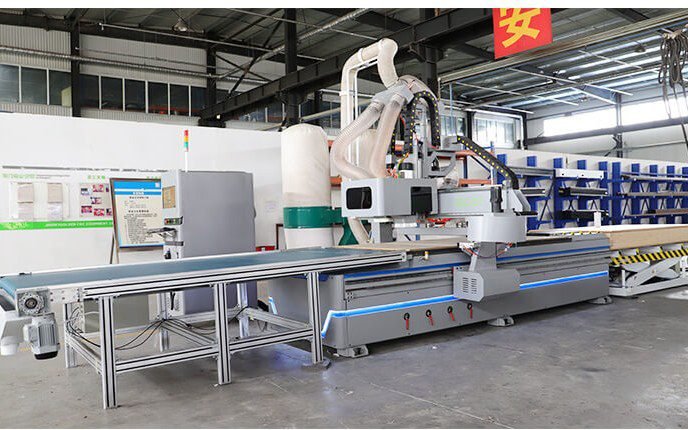
| CNC or drilling centre | Precision work and pre-drilling capability |
| Sanding and spraying or finishing line | Whether finishing is on site or outsourced |
| Assembly area | Joinery and hardware fit at scale |
| Finished-goods warehouse | Real volume of completed stock |
| Packing and labelling | Whether packing matches your crate and room-number plan |
A supplier that can produce all seven scenes in a single live pass is a different candidate from one that can only show a showroom and a few photographs. In our own shop these are exactly the scenes we would want to walk a buyer through on a call, and the ones that are hardest to fake when the request is made live and in sequence.

Third-party remote and on-site inspection. Where the order size justifies it, an independent inspection firm can run a remote or on-site audit that the supplier cannot stage in advance. The cost band reported for a factory audit runs from a few hundred dollars to about $1,500 depending on scope (chinesecheck, 2026), and a pre-shipment inspection is cheaper still. The value is not the report alone; it is that an independent pair of eyes sees the same live floor you are being asked to trust.
Step 4: Reference Projects and the Three Questions
A supplier’s references are the only part of the shortlist where someone else has already been through the process and can tell you how it went. Ask for same-category projects, not the company’s most impressive unrelated work, and ask for the buyer’s contact so you can speak to them directly.
The three questions. When you reach a reference, ask the same three every time.
Who installed the order, and where? This separates a real delivery from a sample that never left the shop. A reference that cannot name an installer or a location is describing a result, not a delivery.
Are there client photographs of the finished work, not just the supplier’s own? This is the question suppliers most often cannot answer, because a customer’s own photographs of an installed kitchen are harder to produce than a marketing render. The willingness to share them is a real signal.
What problems came up, and how were they handled? The most revealing of the three. A supplier with a genuine track record will name the problems and the fixes; one that has been lucky, or that has been trading, tends to keep the answer at all went smoothly.
Where a reference points to a full project of this kind, the same responsibility and sequencing logic we describe for an American villa install, factory does not measure and the local team measures and installs, is what the reference buyer will have lived through (Working with Local Builders and Installers).
What You Cannot Verify Remotely
Being able to shortlist a furniture supplier in China remotely is not the same as being able to decide remotely. Three things genuinely require a physical sample or a visit, and treating them as optional is how a shortlist turns into a regret.
Hand feel and finish. The tactile quality of a door, the consistency of an edge, the way a finish reads in a real room, is not captured by a camera at any resolution a buyer can rely on. A screen can show colour; it cannot show the way a surface moves under the hand.
Batch variation. A sample can be perfect and the production run different. The gap between the two is exactly what an in-line or pre-shipment inspection exists to catch (7 Red Flags When Reviewing a Quotation). A supplier that treats the sample and the batch as the same thing has not met that gap yet.
Real production saturation. A factory that can run your order quietly is not the same as one that can run it while the rest of the floor is already at capacity. That is only visible on site, or through a reference who has ordered at scale and can tell you what happened.
The remote process exists to get you to the two or three suppliers for whom these three checks are worth a sample order and, for the finalist, a visit. It is a filter into a decision, not a substitute for one.
The Shortlist Scorecard
The funnel only works if each candidate is scored the same way. The table below is the scorecard we use: each row is a gate, the weight is how much that gate counts, and the fail column is the line that ends a candidate regardless of everything else on the row.
| Check | What you are scoring | Pass looks like | Fail or red flag | Weight |
|---|---|---|---|---|
| Legal entity | The register matches the seller | Code and name verified on GSXT, active, scope fits | Refuses the credit code; abnormal-listed | High |
| Documentation | Paper backs the capability | Full set, certs verify, real BOM structure | No BOM; a cert that does not verify | High |
| Video audit | The line is real and live | Seven scenes in one unbroken pass | Showroom only; refuses a live walk | High |
| References | Someone else got a good result | Same-category, verifiable, honest on problems | No references, or unverifiable ones | Medium |
| Sample | The finished piece matches | Tactile and finish to spec, labelled | Sample fine, batch flagged as risk | Medium |
| Communication | You can actually work with them | Specific answers, realistic timelines | Vague, deflective, or too fast to yes | Medium |
Two rules sit on top of the score. A High-weight fail is disqualifying no matter how strong the rest of the row is, because a factory that will not show you the line is a factory you cannot shortlist. And the comparison only holds if every name went through the same five gates, which is the whole reason the list stays flat from the start instead of each lead going its own way.
Red Flags That End the Conversation Early
Some signals are so clear that continuing wastes both parties’ time. These are the pre-talk flags, the ones that surface before you ever see a quote, and they are distinct from the quotation red flags covered separately (Reviewing a Supplier’s Quotation).
Refuses to give the legal entity. No credit code, no Chinese name, or a name that does not match the profile. The register check cannot start, so nothing after it is grounded.
Only finished photographs, no workshop. A supplier that can show you a beautiful kitchen but not the floor that made it is describing a result it did not produce.
A certificate that does not verify. The number is not in the issuing body’s register, or the scope does not cover your product. Fail the three-check and the certificate is a fabrication, not a credential.
Refuses a live video, or offers only a cut one. The unscripted route is the test. A supplier that will only perform an edited tour is telling you what the live floor would not show.
Asks for a deposit before a quote is agreed. Payment before scope, price and inspection are all settled is the clearest early warning in the whole process (riwick, 2024).
Everything is yes, immediately. A supplier that accepts every specification without a question is selling the conversation, not the product. The willingness to push back on a detail is itself a data point.
If two or more of these appear together, drop the name and move to the next one in the list. The shortlist is a filter, and its job is to let the weak candidates out cheaply, before they cost you a sample or a visit.
Where the Shortlist Ends and the Order Begins
The three names that survive the funnel are the ones you carry into the real commercial decisions: the quotation, the contract terms and the inspection plan. A shortlist done well does not choose your supplier for you; it chooses the two or three worth the money and time of a proper negotiation. From there the process continues through the cost of a full villa interior, the meaning of MOQ on a smaller first run, and the numbered, pre-drilled, room-packed production that a verified factory actually does (Inside Our Foshan Factory). If you would like the funnel run against a specific project, the working questions start in our buyer FAQ.
Frequently Asked Questions
Can I judge a furniture supplier in China without visiting the factory?
You can shortlist, not decide. The registry check, the documentation test, a live video audit and verifiable references separate most weak candidates from the two or three worth a sample and a visit. The final call still needs a physical sample, and for the finalist a visit.
Is a trading company automatically a bad choice?
No. A trading company is a real structure, and for mixed orders or small quantities it can be the right one. The problem is only when a trader presents itself as a factory. The registry scope and the live video audit tell you which one you are dealing with.
How do I check whether a certificate is real?
Take the certificate number to the issuing body’s own register and confirm it is listed, confirm the issuing body is one you recognise, and confirm the scope and the expiry cover the product you are buying. A number that does not verify is a fabrication, not a certificate.
What should a remote video audit actually show?
A live, unbroken pass through the panel warehouse, the cutting and edgebanding line, the CNC, the finishing line, assembly, and the finished-goods and packing areas, with you choosing the route. A cut video or a showroom-only tour does not count.
Does ordering a sample cost money?
Usually yes, and that is part of the test. A sample is where hand feel, finish and batch consistency get judged, the three things you cannot verify from a screen. The cost of a sample from a shortlisted factory is small against the cost of a full order from one you never properly checked.
How many suppliers should I compare at once?
Keep the active comparison to two or three after the funnel. Comparing twenty in detail is not a comparison, it is a list. The five gates exist to get you from twenty to three so the real comparison can actually happen.