China Furniture Manufacturing 2026: How to Verify a High-End Villa Factory
Most buyers still picture China furniture manufacturing the way it was in 2015: crowded workshops, hand-cut panels, tolerance as a hope. That picture is now as useful for sourcing decisions as a fax machine is for shipping documents. What changed is not one factory getting better — it is an entire cluster in the Pearl River Delta crossing an automation threshold, and the proof is in the numbers.
This guide is the trust side of manufacturing: where high-end villa production actually sits, what 0.01 mm means for your BOM, which compliance documents you are entitled to demand in 2026, and how to read the official export data yourself before you negotiate. Every claim below comes from a source you can open, and every section ends with the exact question you can put in front of a supplier.
In This Guide
- The 2026 baseline: price-driven is over, design-led is the default
- The Foshan cluster: where high-end is actually made
- The precision stack: 5-axis, MES, single clamping
- AI nesting: the material math that should lower your BOM
- The 2026 compliance layer: EUTR/EUDR, BIFMA, and surface tech
- Read the export data yourself before you negotiate
- The verification protocol: seven proofs before you pay
- Frequently Asked Questions
- Is high-end furniture manufactured in China comparable to European production quality?
- Where exactly are the high-end villa interior factories in China?
- How do I verify a factory’s automation claims?
- Which certifications should I demand for a villa project?
- How can I check the export data myself?
- What is a realistic production timeline for a full villa interior order?
The 2026 baseline: price-driven is over, design-led is the default
The custom furniture sector in China moved from price-driven manufacturing and basic customization toward design-led, flexible production during 2025 and into 2026. That sentence is from the industry’s own 2026 trend assessments, and the field data behind it is more concrete than most buyers expect.
A 15-day, 1,500 km field survey of two major Chinese furniture clusters (published by the CIFF Guangzhou supply chain team in March 2026) found that over 50% of leading home-OEM factories have completed full “lights-out” automation upgrades. In the same survey, production cycles on custom panel programs were cut from the traditional 25 days to 7–10 days, which is what finally makes low-MOQ, high-end villa orders economically sensible for a factory.
- A factory that quotes 30+ days for a full villa interior package in 2026 is telling you its line is manual.
- A factory that can run a 2-unit villa order at the same unit economics as a container load has automated nesting and scheduling — and you are entitled to see evidence.
- Tolerance is no longer a negotiation item at the top of the cluster. The advanced lines hold machining accuracy in the 0.01–0.05 mm band, which changes how you write your inspection criteria.
Ask the supplier: “Show me your last three production schedules — from order date to container loading — and the line you would put this villa order on.”
The Foshan cluster: where high-end is actually made
China’s furniture manufacturing is geographically concentrated, and for high-end residential and whole-house customization the concentration is Foshan, Guangdong — specifically the Shunde district pair of Lecong (trading and showrooms) and Longjiang (factories, materials and components).
The China National Furniture Association describes Lecong as the country’s largest furniture distribution and purchasing center, with more than 180 furniture malls and over 4 million square meters of shop space (association figures — undated, so treat them as scale reference, not a 2026 census). The Louvre International Furniture Exhibition Center alone, one complex inside Lecong, publishes a 380,000 sq m figure. The adjacent Longjiang town is where the production lines live.
That Lecong/Longjiang split is the single most important trust fact for buyers:
- A showroom address does not verify a production site. A product displayed in Lecong may be made in Longjiang, Dongguan, or another province entirely.
- Foshan sits next to the Nansha and Yantian ports, which is why full-villa export programs — kitchens, wardrobes, walk-in closets, staircases in one container — are logistically viable at all.
- The cluster’s 2026 identity is design-driven: whole-house customization, designer furniture and upholstered programs, not commodity goods.
When a supplier says “we are a Foshan factory,” the follow-up is not “prove it.” The follow-up is: “Give me the production address, the legal entity name at that address, and the port you ship from.” Those three answers should align.
The precision stack: 5-axis, MES, single clamping
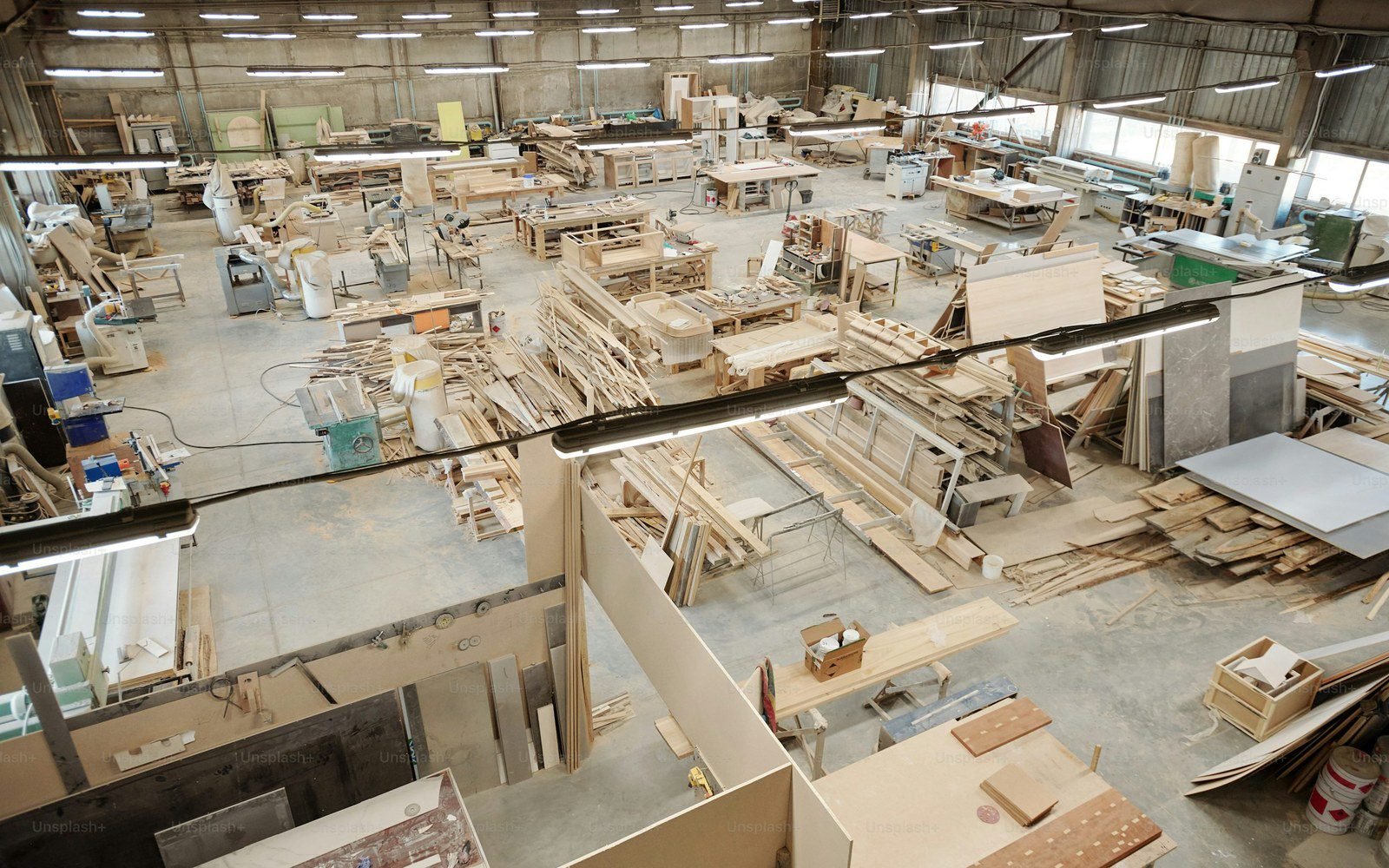
The 2026 survey found leading Foshan factories introducing Italian 5-axis linkage machining centers, connected to MES (manufacturing execution systems) hardware. The operational difference is worth understanding, because it is the layer that separates a villa-grade factory from a cabinet workshop:
- 360° processing in a single clamping. A panel is machined on all faces in one setup. No re-clamping means no re-alignment error — this is why frameless, gap-critical doors and fluted fronts come off the line straight.
- 0.01–0.05 mm machining accuracy, controlled by the MES connection rather than operator skill. Your gap tolerances in the drawing are no longer “the factory’s best effort.”
- Programmed, not remembered. The CNC program is a file. That file is your asset — you can hold it, version it, and use it to audit consistency across batches.
What this means for your verification protocol:
- Ask for the CNC program file (or even a screen recording of it running) for your reference sample. A factory with nothing to hide shares a file freely.
- Request first-article dimensions on your reference sample: at minimum, panel thickness at four corners, edge-band bond, and hinge bore depth.
- Put the 5-axis/single-clamping claim in the production spec sheet — then check the photos at each MES gate (see our villa furniture production process guide for where those gates are).
AI nesting: the material math that should lower your BOM
The same survey documented the most quietly important upgrade in 2026: AI nesting systems. For a genuine leather sofa case, a factory using AI nesting lifts leather utilization from 75% to 88%. In their published case, a sofa requiring 15 m² of leather at $27.78/m² drops from 20 m² actual usage ($555.56) to 17.04 m² ($473.33) — a $82.23 saving per unit before any other cost change.
Veneer panel programs work the same way: AI nesting of veneer sheets from figured wood is where premium-grade material waste historically went, and where a modern factory earns its margin without charging you for it.
This is a BOM item, not a brochure claim. In a 2026 high-end quotation:
- The veneer/wrap-material line should reflect nesting yield, not sheet count.
- You can ask for the nesting report on your reference order — the utilization percentage, the sheet map, the offcut volume.
- If the material line looks padded, that is your margin conversation, handled with a number instead of a guess (how to read the BOM before paying: our BOM walkthrough).
The 2026 compliance layer: EUTR/EUDR, BIFMA, and surface tech
Buyers importing into the EU, the GCC or North America in 2026 are getting a compliance layer that did not exist as a selling point five years ago. Three documented examples from the Foshan ODM tier:
- Deforestation regulation compliance (EUTR/EUDR). Leading ODM players are mass-producing bio-based materials — pineapple-leaf fiber leather and coffee-ground eco-boards — specifically to meet the EU timber regulations, with published carbon-footprint reductions around 80% for the bio-material lines. If your destination is the EU, ask for the chain-of-custody documentation per wood species, not a general “we are eco-friendly” page.
- Surface technology that survives daily use. 172 nm excimer “skin-feel” coatings from Foshan/Guangzhou R&D centers are now standard on the high-end lines: anti-fingerprint and UV-fade resistant, with self-healing properties. Specify it by function in your finish schedule, and ask for a rub/fastness test report on the reference sample.
- Parametric ergonomics. Upholstery programs now use IFD (indentation force deflection) parametric design — the same foam structure tuned firm for Middle Eastern markets, plush for North American. If your villa project crosses regions, this is a spec line, not an afterthought.
For structural goods, BIFMA remains the benchmark the serious factories test against — the Henan steel-furniture cluster publishes BIFMA-conformant products at 25–35% under overseas equivalents, which tells you the testing infrastructure is now commodity-level in China.
Ask the supplier: “Which test reports can you attach to the reference sample — coating fastness, board formaldehyde class, hardware cycle test, and (for EU-bound projects) chain of custody?”
Read the export data yourself before you negotiate
The most underrated trust tool in 2026 is not on any supplier’s website. It is the official trade data, and it is public:
- HS 9401 covers seats (upholstered programs ship here), HS 9403 covers other furniture — including the wooden cabinets and beds a villa interior is made of, HS 9404 covers mattress supports and bedding articles. Keep the heading constant year to year; mixes shift between headings as programs change.
- China Customs’ English portal publishes monthly export values by commodity and destination. UN Comtrade mirrors the bilateral flows so you can cross-check what your destination country reports importing.
- Read the monthly series with a rolling one-year view. Month-to-month furniture export swings are noise; the year-over-year direction by destination and heading is the signal.
What the 2025 data cycle told importers going into 2026: destination diversification as tariff policy differentiated markets (shares rebalancing rather than demand collapsing), migration to higher-specification programs inside heading 9401 (visible in unit values, not volumes), and freight/compliance costs behaving separately from factory prices — the export series prices goods at the border, so landed cost still needs its own model.
Use this as negotiation context, not a weapon: a softening heading tells you factory capacity is competing harder; a growing destination tells you local demand supports price. And it disciplines supplier vetting — a factory claiming decades of export experience across continents should be able to align its history with the trade flows you just read.
The verification protocol: seven proofs before you pay
Everything above collapses into one workflow. Before a high-end villa order leaves the quote stage, collect these seven proofs:
- The 48-hour production drawings. Send the floor plan; receive dimensioned production drawings with a sign-off block. How this works: from floor plan to production drawings.
- The BOM, line by line, before any payment milestone — material lines, hardware brands by model, packaging spec.
- The production address + legal entity + port, and the alignment of all three (the Lecong/Longjiang test).
- The CNC program or screen capture for your reference sample, plus first-article dimensions.
- MES gate photos at cutting, machining, edge banding, assembly and packing — tagged to your order’s unit numbers (the numbered-factory system explained in our villa interiors factory guide).
- Test reports on the reference sample: coating fastness, board class, hardware cycles, chain of custody for EU-bound wood.
- Pre-shipment inspection before the container seals, with a photo log per unit — the full protocol in how to inspect villa furniture before the container seals.
When all seven are in your folder, you are not trusting a supplier — you are contracting with a documented process. That is what china furniture manufacturing at the top of its cluster looks like in 2026: not a promise of quality, but a paper trail of it.
Frequently asked questions
Is high-end furniture manufactured in China comparable to European production quality?
At the top of the cluster, yes — and the gap has closed on precision, where Chinese 5-axis/MES lines hold 0.01–0.05 mm in single clamping. The remaining differentiators are design heritage, brand finish libraries and sometimes lead-time culture. Verify per line, not per country.
Where exactly are the high-end villa interior factories in China?
Foshan, Guangdong — the Lecong (showrooms/trading) and Longjiang (factories/materials) pair in Shunde district — is the concentration for whole-house customization, sitting close to the Nansha and Yantian export ports.
How do I verify a factory’s automation claims?
Ask for the last three production schedules, the CNC program file for your reference sample, MES gate photos tagged to unit numbers, and first-article dimensions. A factory with nothing to hide produces all four within 48 hours.
Which certifications should I demand for a villa project?
Coating fastness reports, board formaldehyde class and hardware cycle tests as baseline; BIFMA for structural items; and chain-of-custody documentation per wood species if your destination is EU-bound (EUTR/EUDR).
How can I check the export data myself?
China Customs’ English portal publishes monthly export values by HS heading and destination; UN Comtrade mirrors bilateral flows. Track HS 9401/9403/9404 on a rolling one-year view, comparing year-over-year direction rather than single months.
What is a realistic production timeline for a full villa interior order?
Automated high-end lines run custom panel programs in 7–10 days per the 2026 CIFF field survey; add reference-sample time (1–2 weeks) and pre-shipment inspection. A quoted 30+ day panel program is a signal of a manual line.
Send your floor plan to a factory that can prove it. If you are planning a villa, hotel suite or full-home customization project, the fastest way to test any China supplier — including ours — is to send the floor plan and watch what comes back within 48 hours: dimensioned production drawings, a BOM, and a line you can walk through at every MES gate. When you send it, include the scale, the room list, your destination market (it changes the compliance layer), and the target loading date. A factory running the 2026 protocol will come back with the production pack and the schedule before the weekend — and you will already know, from the quality of those two documents, where the factory sits in the cluster.
Related reading: villa interior trends 2026 · walk-in closet design trends 2026 · our shipping guide · how to shortlist a furniture supplier in China