Cabinet Door Finishing: HPL vs Lacquer vs Melamine
If you are ordering cabinetry for your villa from China, the finishing question comes up before almost everything else: HPL, melamine, or lacquer? The short answer is that all three are legitimate, and a well-planned villa package usually mixes them. HPL handles the hard-working rooms, melamine keeps the built-ins affordable, and lacquer earns its premium price on the surfaces people actually look at every day. This guide explains what each cabinet door finishing is, where it wins, and exactly what to specify so the finished result matches the sample you approved.
We produce all three finishes in our Foshan factory, so this comparison is based on the panels we cut, edge-band and pack every week — not on catalogue theory. If you are new to ordering interiors from China, start with our complete sourcing guide, then come back here for the finishing details.
In This Guide
The three finishes at a glance
| Finish | What it is | Best for | Cost |
|---|---|---|---|
| HPL (high-pressure laminate) | Multiple resin-impregnated paper layers cured into one solid surface | Kitchens, laundry rooms, high-traffic zones | Medium |
| Melamine | Melamine-resin paper fused to the board face; flat, matte, uniform | Built-ins, flat doors, budget-protecting secondary rooms | Low |
| Lacquer | Multiple UV-cured paint coats on a prepared MDF face | TV walls, islands, display cabinets, statement pieces | Premium |
| Wood veneer | A thin slice of real wood over a stable core board | Feature walls, matched wood packages | Premium |
HPL: the workhorse for high-traffic rooms
HPL is built by laminating several paper layers, each impregnated with resin, under heat and pressure. The surface is therefore a single solid sheet rather than a thin coating on top — which is why it resists scratches, stains, hot pans and moisture the way painted wood never can. Its colour range is huge: matte whites, stone effects and convincing woodgrains, all at a mid price point. For a villa kitchen that gets used every day, HPL base and tall units are the safe default. The detail that separates quality from bargain boards is the edge banding: we tape all edges in matching material (0.4 mm standard, 1 mm on visible edges). That is where cheap cabinets start to peel in year one.
Melamine: the cost-efficient flat option
Melamine is a melamine-resin paper fused directly to the board face. It gives a clean, matte, uniform colour with a softer hand-feel — ideal for long runs of flat doors where you want consistency at a lower cost. The texture depth is shallower than HPL or veneer and the palette is narrower, but for wardrobes, study built-ins, garage and utility rooms, melamine is the rational choice. In a whole-house package we typically specify melamine for secondary rooms on purpose: it protects the total budget so the premium finishes can be concentrated where they matter.
Lacquer: the premium, seamless finish
Lacquer doors are painted: several thin coats of UV-cured paint over a prepared MDF face, then polished or left matte. The result is a seamless, deep, perfectly uniform colour with no visible panel joints — it is the finish behind most “piano black” and high-gloss island fronts. It is also the most delicate of the three: abrasive sponges will mark it, and gloss surfaces show fingerprints. We therefore specify lacquer for the surfaces people photograph and live with — TV feature walls, kitchen islands, display cabinets — and we always recommend ordering a physical sample before committing to a full run.
When you want the look of real wood
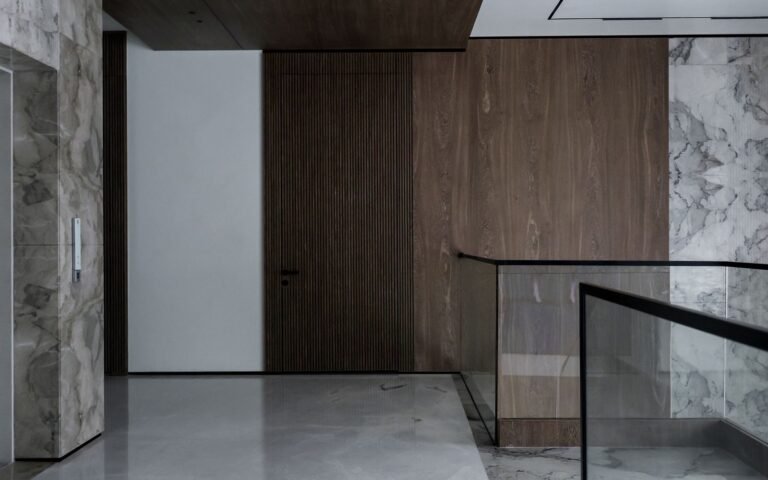
For a genuine woodgrain you have two routes: veneer, a thin slice of real wood applied to a stable core board, or HPL with a pressed wood texture. With veneer, boards are matched door-by-door before cutting, so the grain runs in the direction you chose — that matching step is where the difference between a “wood look” and a real wood feel is made. Dark stains such as smoked oak and espresso walnut read as premium and hide everyday marks well; light stains age gracefully. Whichever route you choose, specify the grain direction and the board matching grade in writing before production starts.

How to choose, room by room
- Kitchen base and tall units: HPL — daily wear, steam and spills
- Kitchen island / statement fronts: lacquer or veneer — the visible centrepiece
- Wardrobes and built-ins: melamine or veneer — closed doors, moderate traffic
- TV / feature walls: lacquer or veneer — the focal point of the room
- Laundry, pantry, garage: melamine — protects the overall budget
- Balcony / outdoor-adjacent: aluminium or marine-grade materials, not any of the three
What to specify when you order
2. Board thickness (18 mm doors, 16–18 mm carcasses)
3. Edge-banding material and thickness (0.4 mm standard / 1 mm visible edges)
4. Colour reference: RAL number for lacquer, texture code for HPL and veneer
5. Sheen: matte, satin or high-gloss
6. A physical sample kit, approved by you, before production starts

Still deciding? Send us your floor plan and we will mark up which finishing belongs in each room, with pricing, before anything is produced. You can see the full workflow on our How It Works page, or browse our Kitchen & Wardrobe solutions to see the finishes we ship most often.